
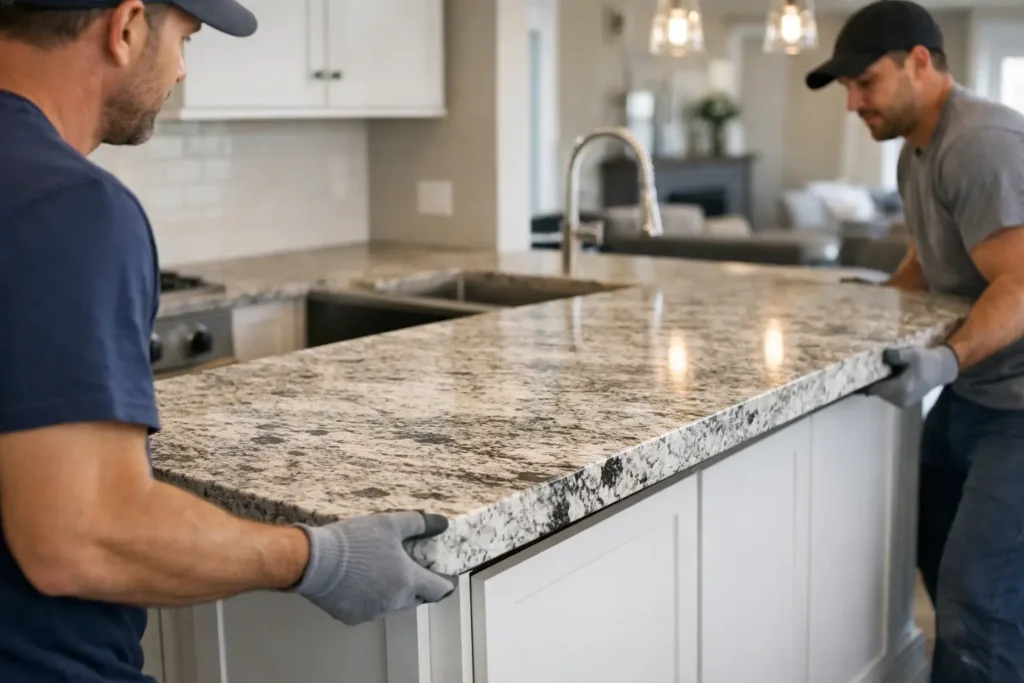
When homeowners search for granite countertop installers near me, they usually need more than a slab set in place. They need accurate measurements, clean cuts, dependable scheduling, plumbing coordination, and an installer who shows up ready to finish the job without dragging the project out for weeks.
That is where many countertop projects go sideways. The stone may be beautiful, but the experience falls apart when materials are delayed, the sink cutout is off, the cabinets are not ready, or three different companies are pointing fingers at each other. If you want the job done right, the installer matters as much as the granite itself.
What to expect from granite countertop installers near me
A qualified granite installer should do more than deliver and drop. They should check that base cabinets are level, confirm final dimensions, account for sink and faucet placement, and make sure the support is right for the weight of the stone. Granite is durable, but it is not forgiving during installation. A bad measurement or weak support system can turn an expensive upgrade into a costly correction.
The best installers also think beyond the countertop surface. They look at backsplash alignment, seam placement, edge finishing, cooktop clearances, and how the stone will meet walls that are rarely perfectly straight. In older homes especially, small framing issues show up fast once a rigid stone slab is involved.
This is why low-price quotes can be misleading. If a contractor skips prep work, rushes templating, or leaves sink hookup and finish details for someone else, the final cost often rises later through delays, change orders, or repairs.
Fast installation depends on more than the stone
Homeowners often assume the biggest delay is choosing granite. In reality, the slowdowns usually come from poor coordination. If cabinets are not installed correctly, countertops cannot be templated. If plumbing fixtures are missing, sink placement can stall. If the installer depends on outside suppliers with long lead times, your schedule starts slipping before work even begins.
That is why a one-company approach makes a real difference. When the same team can supply cabinets, handle countertop installation, manage plumbing connections, and address small interior repairs around the project, there are fewer handoff problems. You are not chasing separate vendors to fix issues that should have been caught on day one.
For busy households, this matters. Most people are not remodeling a kitchen for fun. They want a working sink, usable counters, and a crew that respects their time. Speed only helps if the workmanship holds up, so the right contractor needs both readiness and discipline.
How to compare granite countertop installers near me
Start with the part homeowners often overlook – ask how the company handles the full process, not just the install date. You want to know who measures, who fabricates, who installs, and who is responsible if something is off. A vague answer usually means more subcontracting and less accountability.
Next, ask whether the materials needed for the surrounding work are in stock. A countertop project is tied to more than stone. Cabinets, sinks, faucets, plumbing parts, adhesives, and trim details all affect timing. If those items are backordered, your countertop timeline is not really locked in.
It also helps to ask practical questions that reveal how organized the company is. Will they inspect the cabinets before installation? Do they coordinate sink and faucet cutouts before fabrication? Can they handle disconnecting and reconnecting plumbing if needed? Do they stand behind workmanship after the install is complete? Clear answers usually point to an experienced operation.
Price still matters, of course, but it should not be the only filter. A lower bid can make sense for a very simple layout with no sink relocation, no cabinet issues, and no surprises. In a real home, though, there are usually details that need quick problem-solving. Paying for competence is often cheaper than paying for corrections.
Why in-stock materials matter
A granite countertop job moves faster when the surrounding project pieces are available right away. This is especially true in kitchen remodels where countertops are one part of a larger chain of work. If cabinets are delayed, countertops wait. If sinks or faucets are delayed, final connections wait. If a contractor is sourcing each item from a different place, your schedule depends on everyone else doing their part on time.
That is why homeowners increasingly choose companies that can supply materials and install them under one roof. Cobo Kitchen Master & Home Repair is built around that model. When cabinets, countertops, and core materials are in stock, the project can move forward without the usual stop-and-start delays that frustrate homeowners and stretch budgets.
This does not mean every job is instant. Stone still needs proper measurement, fabrication, transport, and careful setting. But there is a big difference between a realistic project schedule and a project that keeps getting pushed because someone is waiting on inventory.
Common problems a good installer prevents
Granite is a premium surface, but the final result depends on prep and execution. One common issue is uneven cabinet bases. If cabinets are out of level, the slab may not sit properly, which can create stress points or visible gaps. A professional installer catches that before the stone is set.
Another issue is poor seam planning. Some seams are unavoidable, especially on larger layouts or islands, but they should be placed where they make structural and visual sense. Bad seam placement stands out every day you use the kitchen.
Sink installation is another area where experience matters. Undermount sinks need proper support and clean finishing around the cutout. If this part is rushed, you may end up with weak mounting, sloppy edges, or plumbing problems right after the job is supposedly done.
Then there is the simple matter of protecting the home during installation. Granite is heavy. Moving slabs through occupied homes requires planning, care, and the right equipment. A disciplined crew protects floors, walls, and cabinets instead of treating your house like a jobsite free-for-all.
When granite is the right choice and when it depends
Granite remains a strong option for kitchens because it handles heat well, offers natural variation, and adds long-term value. Many homeowners prefer it because no two slabs look exactly alike. It can also hold up well in busy family kitchens when it is properly sealed and maintained.
Still, the right choice depends on how you use the space. If you want a perfectly uniform pattern, quartz may fit better. If you are working around existing cabinets with structural concerns, the weight of granite needs to be considered. If your layout involves complex corners, waterfall edges, or tight appliance clearances, installation skill becomes even more important.
That is why the installer should help you think through function, not just appearance. A good contractor does not push one surface for every job. They look at your cabinets, plumbing setup, timeline, and how you actually use the kitchen.
What homeowners should do before the install date
Before installation, clear the countertops, empty nearby lower cabinets, and make sure there is a path for the crew to move material safely. If pets or small children are in the home, plan to keep them out of the work area. Stone installation is not loud in the same way as demolition, but it does require space and control.
You should also confirm who is handling plumbing disconnection and reconnection. This step gets missed more often than it should. A countertop can be perfectly installed, but if the sink, faucet, or drain work is left hanging, your kitchen is still not functional.
Finally, confirm the finish details in writing before work starts. That includes edge profile, backsplash scope, sink type, faucet holes, seam expectations, and timeline. Good contractors appreciate clarity because it keeps the job moving.
The right local installer saves time, stress, and rework
Searching for granite countertop installers near me is really a search for reliability. Homeowners want a company that can measure correctly, install professionally, coordinate related trades, and keep the project moving without excuses.
The strongest choice is usually not the company with the flashiest pitch. It is the one that is ready to work, clear about responsibility, and equipped to handle the full job with guaranteed workmanship. When your contractor can supply materials, install them properly, and solve the surrounding issues at the same time, the project gets simpler fast.
If you are planning new countertops, look for a team that treats timing, craftsmanship, and accountability as part of the same job. That is what turns a countertop upgrade into a finished kitchen instead of a half-complete project waiting on the next phone call.