
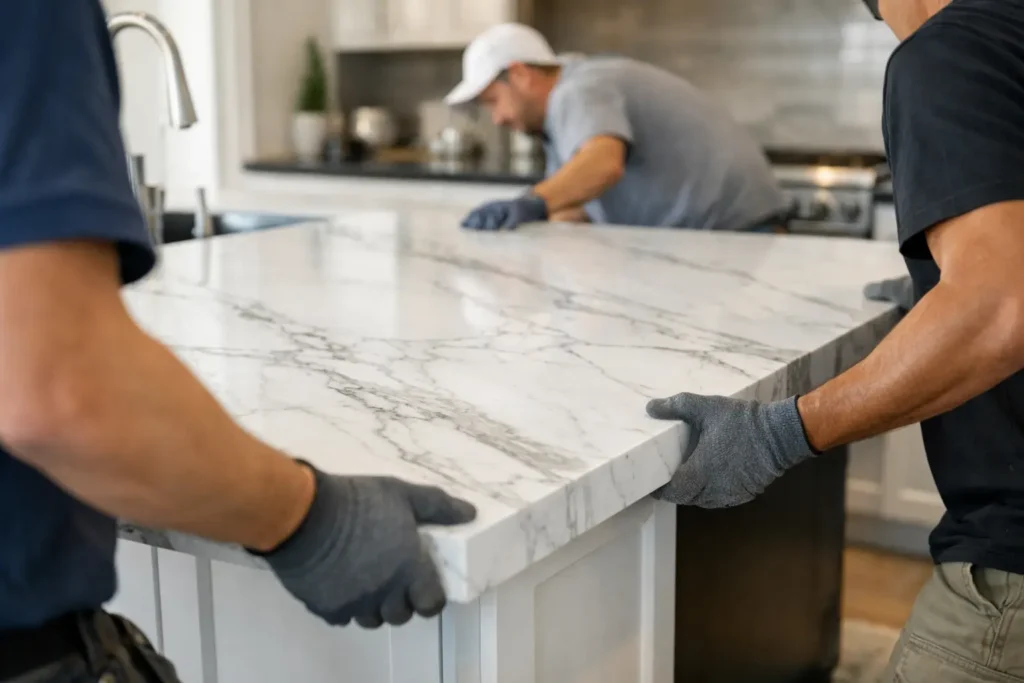
A marble slab can make a kitchen look finished in a way few materials can. But marble countertop installation is not the kind of job that forgives rushed measurements, weak cabinet support, or sloppy seam work. If the goal is a countertop that looks clean, sits level, and holds up to daily use, the installation matters just as much as the stone itself.
Why marble countertop installation needs precision
Marble is beautiful, but it is not a low-stakes material. It is heavy, it can crack if handled poorly, and natural variation means no two slabs behave exactly the same way. That is why installation is never just about getting the top into the room and setting it in place.
The base cabinets have to be level. The substrate and support have to match the slab size and overhang. Sink cutouts and faucet holes need to be planned correctly before the stone is set. If any of those steps are off, the final result can shift from premium to problematic fast.
Homeowners usually notice the finish details first – the seam, the edge, the fit against the wall. What they do not always see is that those details depend on good prep. A marble top only looks right when the structure underneath is right.
What happens before installation day
The most important part of the project often happens before the slab arrives. Measurements need to be exact, not close. In kitchens and bathrooms, small errors create visible gaps, bad sink alignment, and stress points in the stone.
That starts with cabinet condition. If cabinets are old, loose, or out of level, they may need adjustment before installation. Marble is not the material to use as a fix for uneven cabinetry. The stone should rest on a stable base, not compensate for one.
Template work also matters. This is where the layout gets locked in – appliance clearances, wall variations, sink placement, and edge profile. In many homes, walls are not perfectly straight, and corners are rarely perfect 90-degree angles. Good installers account for that instead of forcing a slab into a space that was never truly square.
If this is part of a larger remodel, timing matters too. Plumbing, cabinets, and backsplash planning all affect the install. One of the biggest causes of delay is when materials are available but the space is not ready. A one-company approach helps because the same team can coordinate the moving parts instead of leaving the homeowner to manage multiple schedules.
The biggest decisions that affect the final result
Not every marble install follows the same path. The right approach depends on the slab, the room, and how the space will be used.
Slab thickness and support
Thicker marble can create a stronger visual impact, but weight increases fast. That may require more support, especially around sink cutouts, cooktop openings, or extended overhangs. A breakfast bar overhang, for example, may need brackets or reinforcement depending on the span.
This is where shortcuts cause trouble. Unsupported areas are more likely to crack over time, especially in busy kitchens where people lean on counters or place heavy appliances near vulnerable sections.
Finish and edge profile
Polished marble reflects light and highlights veining, but it also shows etching and surface wear more easily. Honed marble gives a softer look and can hide some use patterns better, though it still requires care. Neither finish is automatically better. It depends on whether the homeowner wants a brighter, more formal appearance or something slightly more forgiving day to day.
Edge choice changes both style and durability. A simple eased edge fits most kitchens and keeps the look clean. More decorative profiles can look upscale, but they may be more prone to chipping in active family spaces.
Seams and layout
Most homeowners want as few seams as possible. That makes sense, but it is not always realistic depending on slab size, kitchen shape, and access into the home. A good install does not just minimize seams – it places them where they make structural and visual sense.
Natural veining adds another layer. Some slabs can be matched for continuity, while others have movement that makes perfect blending impossible. Honest planning matters here. It is better to know in advance how the stone will read across a seam than to be surprised after installation.
What to expect during marble countertop installation
On installation day, the room should already be ready. Cabinets should be secured, the old tops removed, and the area clear for safe handling. Marble is heavy and awkward to move, so experienced installers work carefully and deliberately.
The slab is dry-fit first to check alignment, fit, and support. Any adjustments are made before final setting. Once the slab is placed, seams are joined, the top is leveled, and sink areas are checked again for fit and stability. If there is a backsplash component or side splash, that gets aligned to the walls and the countertop surface.
This is also the stage where details matter most. A clean install should have tight joints, consistent reveal lines, and no rocking or hollow support areas. The top should look intentional from every angle, not like it was forced into place.
After that, the installer may seal the marble depending on the product and finish selected. Plumbing reconnection usually follows once the sink and faucet openings are confirmed.
Common problems that come from poor installation
Most countertop complaints are not really about the stone. They come from bad execution.
A visible lippage at the seam, poor support around the sink, uneven overhangs, or a gap against the wall can all trace back to prep or install errors. Cracks near cutouts often happen because the slab was stressed during handling or not supported correctly once installed.
Another common issue is rushing the schedule. If the cabinet install is incomplete, if plumbing rough-ins are off, or if measurements were taken before the room was truly ready, the countertop becomes the piece everyone tries to make fit. That usually costs more time and money in the end.
For homeowners, this is why speed should mean readiness, not rushing. Fast service only helps when the company has the materials, the crew, and the process to do the work correctly.
Marble in a real home – not just a showroom
Marble has a reputation for luxury, and that part is earned. It also has a reputation for needing care, and that part is true too. It can etch from acidic spills. It can stain if left unsealed or if spills sit too long. In a busy kitchen, that trade-off needs to be understood before the install happens.
That does not mean marble is a bad choice. It means the right homeowner for marble is someone who values natural stone and understands that lived-in surfaces change over time. Some people see that patina as character. Others want something more resistant and lower maintenance. There is no reason to pretend those are the same customer.
In bathrooms, marble often has an easier life than it does in kitchens. In kitchens, it can still work well, especially when the install is solid and the owner is realistic about care. The mistake is choosing marble for the look alone without considering how the space is actually used.
Why one-team coordination makes a difference
Countertop work sits in the middle of several trades. Cabinets have to be right. Plumbing has to line up. Sink and faucet selections have to be confirmed. If each part is handled by a different company with a different schedule, delays and finger-pointing become part of the project.
That is where a full-service company has a real advantage. When supply and installation are handled together, there is less waiting, less confusion, and fewer opportunities for details to get lost between vendors. Cobo Kitchen Master & Home Repair is built around that kind of coordination – in-stock materials, installation readiness, and one team accountable for the result.
For homeowners, that means fewer calls, fewer delays, and a clearer path from measurement to finished countertop.
How to know you are ready to move forward
If you are considering marble, the first question is not just which slab you like. It is whether the room, the cabinetry, and the project timeline are ready for a precise install. Good marble countertop installation starts with stable cabinets, accurate templates, and a team that understands both stone work and the surrounding trades.
The right install gives marble what it needs to perform well – proper support, careful handling, clean finishing, and no guesswork. That is what turns a high-end material into a lasting part of the home instead of an expensive problem.
If you want marble, do not settle for a fast promise without a solid process behind it. The best-looking countertop in the room is usually the one installed by a team that was ready before the slab ever showed up.