
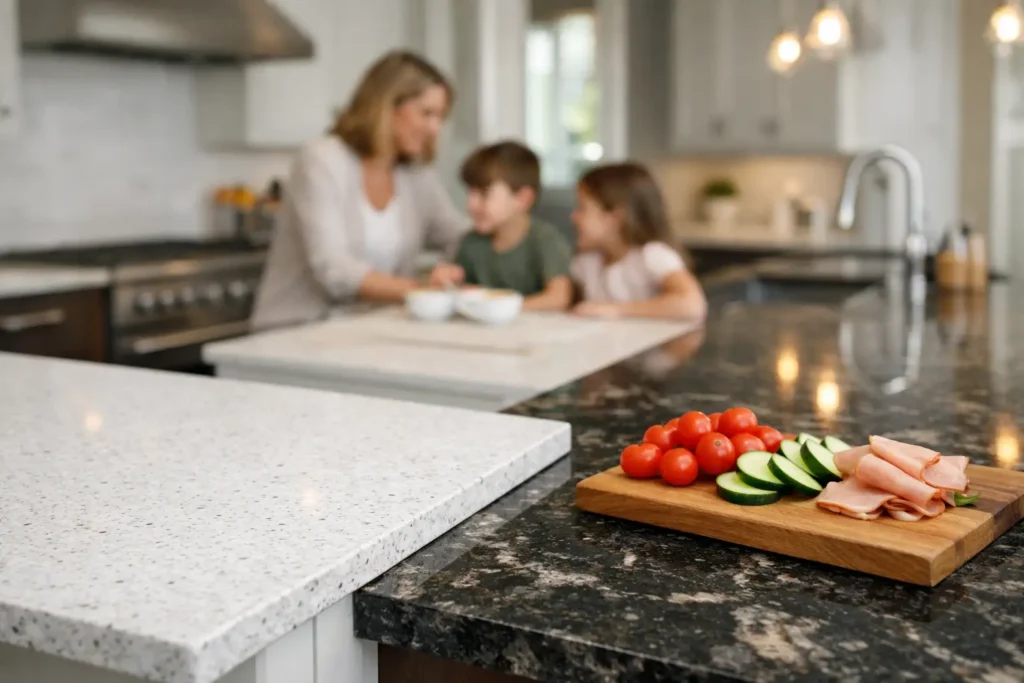
A family kitchen does not stay pristine for long. It handles rushed breakfasts, school projects, hot pans, grocery bags, birthday cakes, homework, and the occasional spilled juice box. When choosing granite or quartz for family kitchens, the best material is not simply the one that looks good in a showroom. It is the one that matches how your household actually cooks, cleans, and uses the space.
Both granite and quartz can deliver a durable, high-value countertop. The right choice comes down to the trade-offs: natural character versus a more uniform look, heat tolerance versus stain resistance, and periodic sealing versus lower routine maintenance.
Granite or Quartz for Family Kitchens: Start With Daily Use
If your kitchen is the busiest room in the house, start with the questions that affect your schedule. Do children leave wet cups on the counter? Do you regularly place baking sheets or cookware down while serving dinner? Are you looking for a consistent color across a large island and perimeter counters? Do you want a material that needs as little upkeep as possible?
Quartz is often the practical choice for families who want an easy-to-clean surface with predictable color and pattern. Granite is often the better fit for homeowners who want a one-of-a-kind natural stone look and stronger tolerance for everyday heat. Neither answer is automatic. A countertop should work with your cooking habits, budget, cabinets, sink, and installation plan.
Why Families Choose Quartz
Quartz countertops are engineered from natural quartz minerals combined with resins and pigments. This creates a nonporous surface that does not require sealing under normal use. For a household that already has enough chores, that is a meaningful advantage.
Better protection against common stains
Juice, cooking oil, coffee, tomato sauce, and food coloring are part of family life. Because quartz is nonporous, it is highly resistant to staining when spills are wiped up in a reasonable amount of time. It also resists moisture penetration, which can make cleanup around the sink, beverage station, and breakfast bar easier.
For many homeowners, the daily routine is simple: use a soft cloth, mild soap, and water. Avoid harsh chemicals, abrasive scrub pads, and strong degreasers that can dull the finish or affect the resin binders.
A more controlled, consistent appearance
Quartz gives you more control over the final look. It is available in clean whites, soft grays, warm neutrals, bold dark colors, and designs that resemble marble or natural stone. If you want your island and surrounding counters to have a closely matched pattern, quartz makes that easier.
That consistency is especially helpful in a kitchen remodel where cabinetry, backsplash, flooring, and fixtures all need to work together. You know more clearly what you are getting before fabrication begins.
The heat trade-off
Quartz is tough, but it is not a surface for placing a hot skillet or roasting pan directly from the oven. Excessive heat can damage the resin in the material, causing discoloration, cracking, or a permanent burn mark. Trivets and hot pads are not optional if hot cookware frequently lands on the counter.
Quartz can also chip along exposed edges if it takes a hard impact. A professional fabricator can help reduce that risk by recommending an edge profile that suits the way your family uses the kitchen.
Why Families Choose Granite
Granite is a natural stone, cut from a slab rather than manufactured to a uniform design. Every slab has its own veining, mineral movement, color shifts, and character. That variation is exactly why many homeowners choose it.
Natural beauty that does not look manufactured
No two granite countertops are identical. A slab can bring depth and movement that becomes the focal point of a kitchen, especially when paired with simple cabinets. Dark granite can create a strong contrast against white cabinetry, while lighter options can add warmth without making the room feel busy.
The key is viewing the actual slab before final selection. A small sample cannot show the full variation, veining, or color range that will appear across a large island.
Better tolerance for heat
Granite generally handles heat better than quartz, which matters in homes where people cook often. You still should not treat any countertop as a landing zone for extremely hot cookware. Sudden temperature changes, concentrated heat, seams, and surrounding materials can still be affected.
Still, if your routine includes baking, large family meals, and frequent stovetop cooking, granite provides more peace of mind around normal kitchen heat. Use trivets as good practice, but granite is typically more forgiving in this area.
Sealing and maintenance are part of ownership
Granite needs sealing to help protect it from stains and moisture. How often depends on the stone, the quality of the original sealer, and the amount of use. Some granite may need attention every year or two, while denser materials can go longer.
This is not a difficult job, but it is a responsibility. If you know the countertop will receive minimal care beyond daily wipe-downs, quartz may be the more realistic choice. With proper sealing and cleaning, though, granite performs well for decades.
Durability: The Real-World Comparison
Both materials are durable enough for active family kitchens, but they fail differently. Quartz is highly scratch-resistant and gives strong stain protection, but it is more sensitive to direct heat. Granite is hard, heat-tolerant, and naturally durable, but it needs sealing and can stain if its protection wears down.
Neither countertop is indestructible. Knives can dull against both surfaces, so always use a cutting board. Heavy pots can chip an edge if dropped. And no homeowner should use abrasive cleaning products simply because a countertop is marketed as durable.
For households with young children, quartz often wins on easy cleanup. For serious home cooks or families that frequently prepare large meals, granite may win because of its natural appearance and heat tolerance. If your kitchen habits fall somewhere in the middle, the final decision may come down to the specific slab or quartz color you prefer.
Cost Is More Than the Material Price
Do not compare granite and quartz by a single square-foot number. Price changes based on material grade, slab availability, thickness, color, edge detail, cutouts, backsplash, sink installation, removal of old counters, and the amount of fabrication required.
A low material quote can become expensive if it does not include accurate measuring, professional fabrication, delivery, installation, sink cutouts, plumbing reconnection, or cleanup. The same is true when a project is split between separate suppliers and installers. Delays and miscommunication often cost more than homeowners expect.
For a family kitchen, value means getting a countertop that fits correctly, is properly supported, has clean seams, and is installed without leaving you to coordinate the next trade. Countertops also need to work with the cabinet layout, overhang requirements, sink type, faucet placement, and any appliance changes planned for the remodel.
Installation Can Make or Break Either Countertop
A quality slab will not perform as it should if the cabinets are uneven, the measurements are rushed, or the sink and faucet are installed incorrectly. Before fabrication, cabinets should be securely installed and checked for level. This is especially important with large islands, heavy stone, and extended overhangs.
Professional installation also matters around seams, corners, cooktop cutouts, and undermount sinks. These areas carry stress and need careful support. If plumbing must be disconnected or reconnected during the countertop replacement, using one accountable team reduces the chance of finger-pointing between contractors.
Cobo Kitchen Master & Home Repair helps homeowners avoid that fragmented process by supplying materials and handling the installation work in one coordinated project. When cabinets, countertops, sinks, faucets, and repair needs are addressed together, there are fewer avoidable delays and fewer surprises once work begins.
Make the Choice Based on Your Household
Choose quartz if easy stain resistance, minimal maintenance, and a consistent design are your top priorities. It is a strong fit for busy households that want a polished look without adding countertop sealing to the maintenance list.
Choose granite if you value natural variation, want stronger heat tolerance, and do not mind periodic sealing. It is a smart choice for homeowners who want the character of real stone and a surface that stands up well to active cooking.
Before making a final selection, look at full-size samples in your kitchen lighting, ask what is included in the installation scope, and confirm material availability before setting the project schedule. The right countertop is the one your family can use confidently every day – without turning normal kitchen life into something you have to worry about.