
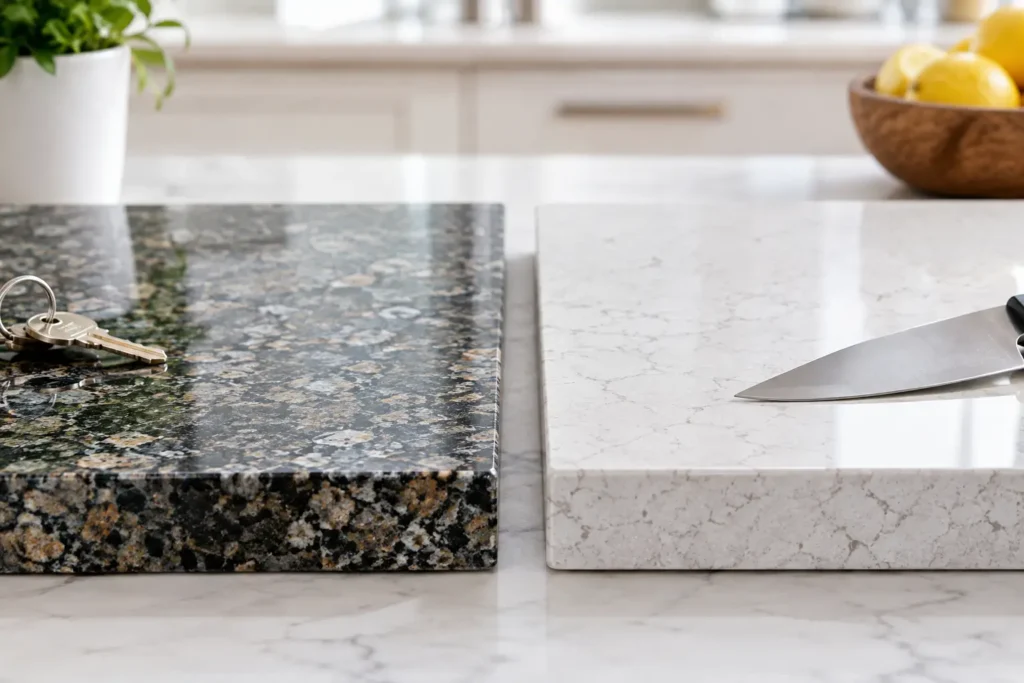
A countertop has to handle more than a few dinner plates. It sees hot pans, dropped glasses, rushed breakfasts, kids’ homework, cleaning products, and years of daily use. When homeowners ask about granite versus quartz durability, they usually want a clear answer: Which surface will hold up without creating another repair project?
Both granite and quartz are strong, long-lasting countertop materials. Neither is automatically the right choice for every kitchen. The better option depends on how you use the space, how much maintenance you are willing to do, and whether heat resistance or stain resistance matters more in your household.
Granite Versus Quartz Durability at a Glance
Granite is a natural stone cut from slabs, while quartz countertops are engineered from crushed quartz minerals bound with resin. That difference affects how each material performs under real kitchen conditions.
Granite has excellent natural heat resistance and a hard surface that can last for decades when properly installed and maintained. Because it is porous to some degree, it needs periodic sealing to help prevent stains and moisture absorption.
Quartz is nonporous, highly consistent, and exceptionally resistant to everyday stains. It does not need sealing. Its main limitation is heat: the resins that bind the material can discolor, crack, or scorch when exposed to extreme temperatures.
For a busy family kitchen, quartz often wins on low-maintenance durability. For households that frequently cook with cast iron, use hot cookware, or want a one-of-a-kind natural slab, granite can be the more forgiving surface in the right areas.
Heat Resistance: Granite Has the Edge
Hot cookware is one of the clearest differences between the two materials. Granite is formed under intense natural heat and pressure, so it handles normal kitchen heat very well. A hot pot set down briefly is less likely to damage granite than quartz, although using trivets is still the smart habit. Sudden temperature changes can affect any stone surface, especially near edges, seams, or existing weak points.
Quartz should not be treated like a landing zone for hot pans. Its mineral content is strong, but the resin portion is vulnerable to high heat. A pan fresh from the oven, slow cooker insert, electric griddle, or air fryer basket can leave permanent discoloration or cause thermal cracking. This is not a minor concern in kitchens where several people cook at once.
If heat exposure is part of your daily routine, granite gives you more room for error. If you choose quartz, plan for trivets near the range, oven, and serving areas from day one.
Stains and Moisture: Quartz Makes Cleanup Easier
Quartz has a sealed factory finish and a nonporous surface. Coffee, oil, wine, tomato sauce, juice, and common household messes stay on the surface instead of soaking in. Wiping up spills with mild soap and water is usually enough.
Granite can resist stains well, but its performance depends on the specific slab and the condition of its sealer. Some granite colors and patterns are denser than others. A properly sealed granite countertop is practical for everyday cooking, but neglected sealing can allow oil, wine, or other liquids to darken the stone.
This does not mean granite is difficult to own. It means it requires a maintenance step that quartz does not. Most homeowners can manage granite sealing without trouble, but a busy household should be realistic about whether that task will happen consistently.
What about bacteria and food preparation?
A clean, properly maintained countertop is suitable for normal food prep whether it is granite or quartz. Quartz’s nonporous surface makes it especially simple to clean after messy meals. With granite, keeping the sealer in good condition helps prevent moisture and residue from entering the stone.
Avoid harsh chemicals on both materials. Strong oven cleaners, paint removers, drain cleaners, and abrasive pads can damage the finish, dull the surface, or weaken seams. Countertop durability starts with the material, but daily cleaning habits still matter.
Chips, Scratches, and Cracks
Both materials are hard enough for normal kitchen use, but neither is indestructible. The most vulnerable spots are edges, corners, cutouts around sinks and cooktops, and seam areas. A dropped cast-iron pan can chip either countertop, particularly on a squared or decorative edge.
Granite is very scratch-resistant. Knives can dull quickly if used directly on it, so a cutting board protects both your blades and the countertop. Granite can chip under a sharp impact, but many minor chips can be repaired or blended by a qualified stone professional.
Quartz is also highly scratch-resistant and holds up well against routine use. However, it can chip at edges and may crack if cabinets are not level or the countertop is poorly supported. Because quartz patterns are engineered, a repair may be more visible depending on the color and design.
Installation matters as much as the slab itself. Cabinets need to be level, sink and cooktop cutouts need proper reinforcement, and seams need skilled fabrication. Even the strongest countertop can fail early when rushed or installed over an uneven base.
Sunlight and Color Stability
Most indoor kitchens do not have a major issue with sunlight, but this factor matters in rooms with large windows, sunrooms, or outdoor cooking areas.
Granite generally performs well in sunlight because it is natural stone. Some slabs may change subtly over many years, but it is typically a dependable option for bright spaces and outdoor applications when the specific stone and installation method are appropriate.
Quartz is best kept indoors. Extended direct UV exposure can fade or yellow the resin in some products, especially lighter colors. A sunny breakfast nook is not automatically a problem, but an uncovered outdoor kitchen is usually not the right place for standard indoor quartz.
Maintenance: The Durability Cost Most People Miss
Durability is not only about whether a countertop can crack. It is also about how much work it takes to keep it looking good.
Quartz is the lower-maintenance choice. It does not need sealing, and ordinary spills are easy to manage. Use a soft cloth, mild dish soap, and water for routine cleaning. For dried residue, use a nonabrasive cleaner approved for engineered stone.
Granite requires periodic sealing, especially in high-use kitchens. The schedule varies by slab, sealer, and household use. A simple water test can help: if water darkens the stone instead of beading on top, the surface may be ready for resealing. With that basic care, granite can remain beautiful and dependable for decades.
Neither surface should be used as a cutting board or cleaned with abrasive scouring pads. Do not sit or stand on countertop overhangs, and do not assume a thick-looking slab can support concentrated weight without proper brackets.
Which Countertop Is Right for Your Kitchen?
Choose granite if you want natural variation, strong heat resistance, and a countertop that can take the demands of frequent cooking. It is a practical choice for homeowners who do not mind periodic sealing and want the character that only natural stone provides.
Choose quartz if you want consistent color, easy cleanup, and strong protection from stains without ongoing sealing. It works especially well for busy households, rental properties, and kitchens where spills happen often but hot cookware can be kept on trivets.
Budget can also affect the decision, but material price is only part of the project. Accurate measuring, cabinet condition, fabrication quality, seam placement, sink support, and professional installation all affect the final result. A lower-priced slab installed poorly is not a durable bargain.
Get the Installation Right From the Start
A countertop should fit your kitchen, your cooking habits, and the condition of the cabinets underneath it. Before selecting a color, inspect the base cabinets, decide where hot cookware will land, and consider how much direct sunlight reaches the room. These details prevent avoidable damage later.
Cobo Kitchen Master & Home Repair helps homeowners coordinate countertop selection, cabinet work, and installation with one accountable team. The goal is simple: a finished kitchen that is ready for daily use, not a project delayed by missing materials or disconnected contractors.
The best countertop is the one that matches the way your household actually lives. Pick the surface you can protect with realistic habits, then make sure it is measured, supported, and installed with the same care you expect it to deliver every day.