
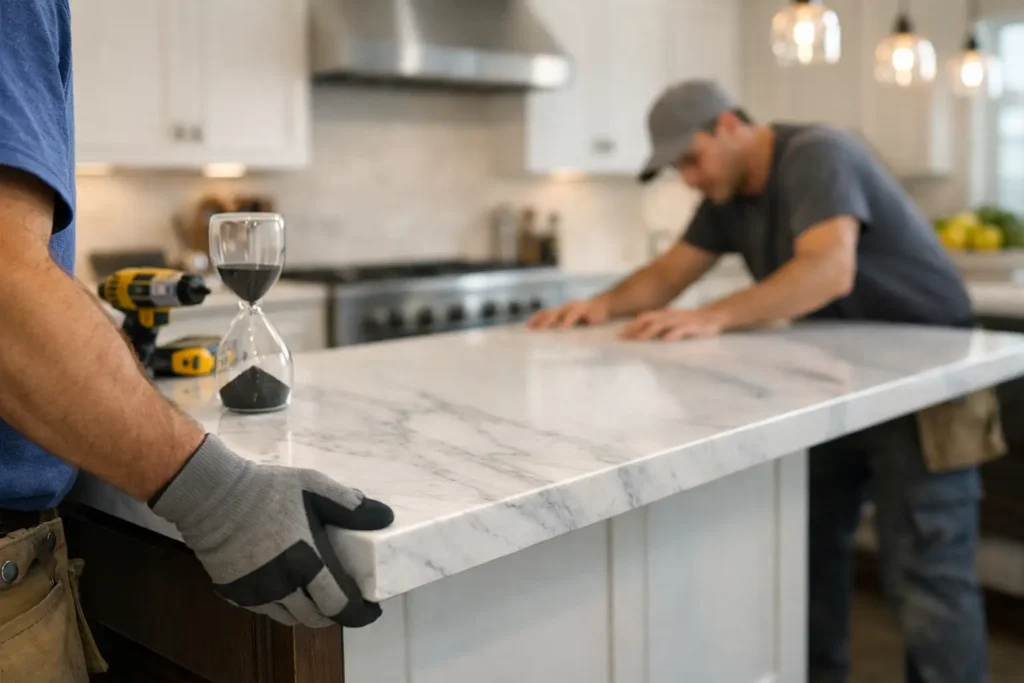
If your sink is disconnected, your old tops are coming out, and you are trying to plan meals around a half-finished kitchen, one question matters fast: how long does countertop installation take? The short answer is that the on-site installation is often done in one day, but the full process can take anywhere from a few days to a few weeks depending on the material, measurements, sink cutouts, and whether the product is in stock.
That gap between install day and total project time is where most homeowners get frustrated. They hear “one-day install” and assume the whole job starts tomorrow and ends by dinner. Sometimes it does move quickly. Sometimes it does not. The difference usually comes down to preparation, material availability, and whether one company is handling the job from start to finish.
How long does countertop installation take from start to finish?
For most homes, the full countertop timeline includes templating, fabrication if needed, removal of the old countertop, installation of the new one, and final plumbing or backsplash work. If the countertop material is in stock and the kitchen is ready, the process can move much faster than many people expect. If there are custom cuts, specialty materials, or missing cabinets, the schedule stretches.
A basic timeline often looks like this. Measuring or templating usually happens first and can take a few hours. Fabrication may take several days to two weeks depending on the material. The actual installation is commonly finished in one day. Plumbing reconnection for sinks and faucets may happen the same day or the next day, depending on how the crew is scheduled and whether adhesives or sealants need time to set.
So if you are asking how long does countertop installation take, the practical answer is this: the install itself is usually one day, but the full process is often 3 days to 2 weeks, and sometimes longer for highly custom work.
What affects countertop installation time?
The biggest factor is the material. Laminate and some prefab countertops are usually faster because they require less fabrication. Granite, quartz, and marble often involve templating, slab cutting, edge finishing, and sink or cooktop cutouts before install day even arrives.
Cabinet readiness also matters more than many homeowners realize. Countertops cannot be installed properly if the base cabinets are not level, secure, and fully in place. If cabinet installation is still unfinished, the countertop timeline pauses. That is why full-service contractors often move faster than split teams. When one company handles cabinets, counters, plumbing, and adjustments, there is less waiting and less finger-pointing.
The size and shape of the job matters too. A straight run in a small kitchen is simpler than a large layout with corners, waterfall edges, multiple seams, a farmhouse sink, or an island. Bathrooms are often quicker than kitchens because there is less square footage and fewer cutouts.
Then there is product availability. This is where projects either move or stall. If your selected countertop is in stock, the process can start much sooner. If it needs to be special ordered, you may wait before fabrication even begins.
Material makes a real difference
Laminate is usually the quickest option. If you choose a standard size or prefab style, install can happen fast once measurements are confirmed.
Quartz and granite tend to fall in the middle. They are popular because they offer durability and value, but they usually require fabrication time. Once the slabs are ready, the install itself is still often completed in a day.
Marble, butcher block, concrete, and other specialty materials can add time. Some need more careful handling. Others need finishing or sealing on site. That does not make them a bad choice, but it does mean the timeline deserves a more realistic conversation upfront.
Sink and plumbing details can extend the job
Undermount sinks, cooktops, faucet hole drilling, and plumbing reconnections all affect the schedule. If the sink arrives late, does not match the cutout, or requires special mounting hardware, a simple countertop install can turn into a stop-and-start job.
This is another reason homeowners benefit from working with one team that can supply and install related components. When the countertop crew and plumbing team are coordinated, there is less chance of losing days over a missing part or a scheduling conflict.
What happens on installation day?
Installation day is usually the shortest part of the process, but it is also the most visible. The crew will typically remove the old countertop first, if that is part of the job. Then they prepare the cabinet surfaces, dry-fit the new countertop, make sure seams are aligned, secure the material, and apply adhesive or caulk where needed.
If the countertop is stone, crews may need extra time for leveling, seam work, and careful placement because the material is heavy and less forgiving. If there is a backsplash included, that may be installed the same day or scheduled separately.
Homeowners often ask whether they can use the kitchen right away. Usually, light use depends on the material and what else was installed that day. You may need to wait before reconnecting plumbing, using the sink, or placing heavy items on the surface. A good installer will tell you exactly when the area is safe to use.
Why some countertop jobs take longer than expected
Delays usually do not come from the final install itself. They come from the steps around it. Incorrect measurements are a major one. If the template is wrong, the slab or countertop section may need to be recut or remade. That costs time and money.
Another common issue is hidden damage. Once the old countertop is removed, crews sometimes find water damage, wall issues, or cabinet movement that needs repair before the new top can go in. Rushing past that step is a mistake. A fast job is good. A fast job that ignores the structure underneath is not.
Scheduling delays also happen when homeowners are coordinating multiple vendors. One company measures. Another fabricates. Another installs. A plumber comes later. If one step slips, the whole calendar shifts. That is why speed is not just about labor. It is about coordination.
How to keep your countertop project moving
The fastest countertop projects are usually the best-prepared ones. Choose your material early and confirm that it is available. Make sure cabinets are installed, level, and finished before the countertop team measures. Have your sink, faucet, and cooktop selected ahead of time so cutouts and plumbing details are accurate.
It also helps to clear the work area completely. Remove small appliances, dishes, and anything stored under the sink. If the crew has to wait while the space is emptied, you are using installation time on cleanup instead of progress.
Most important, work with a contractor who can control more of the process. A company with in-stock materials and installation capability can often cut days or even weeks off a project simply because the parts and labor are already lined up. That is one reason homeowners choose a provider like Cobo Kitchen Master & Home Repair when they want fewer delays and one point of accountability.
A realistic timeline by project type
A small bathroom vanity top may be measured and installed within a few days if the material is ready. A standard kitchen with in-stock material may move from measurement to installation in under a week. A custom kitchen with specialty stone, a large island, multiple cutouts, and backsplash work may take one to three weeks.
There is no honest one-size-fits-all promise here. If someone tells you every countertop job takes exactly the same amount of time, that is not experience talking. What matters is whether the installer can explain the timeline clearly, identify likely delays before they happen, and keep the work moving once the schedule starts.
If you are planning around family routines, tenants, or a home sale, ask two separate questions instead of one. Ask how long the physical installation will take, and ask how long the entire project will take from approval to completion. That is how you get a timeline you can actually use.
A good countertop job should move quickly, but it should also move correctly. The best outcome is not just a fast install day. It is a countertop that fits right, looks right, and lets you get your kitchen or bath back without another round of repairs.