
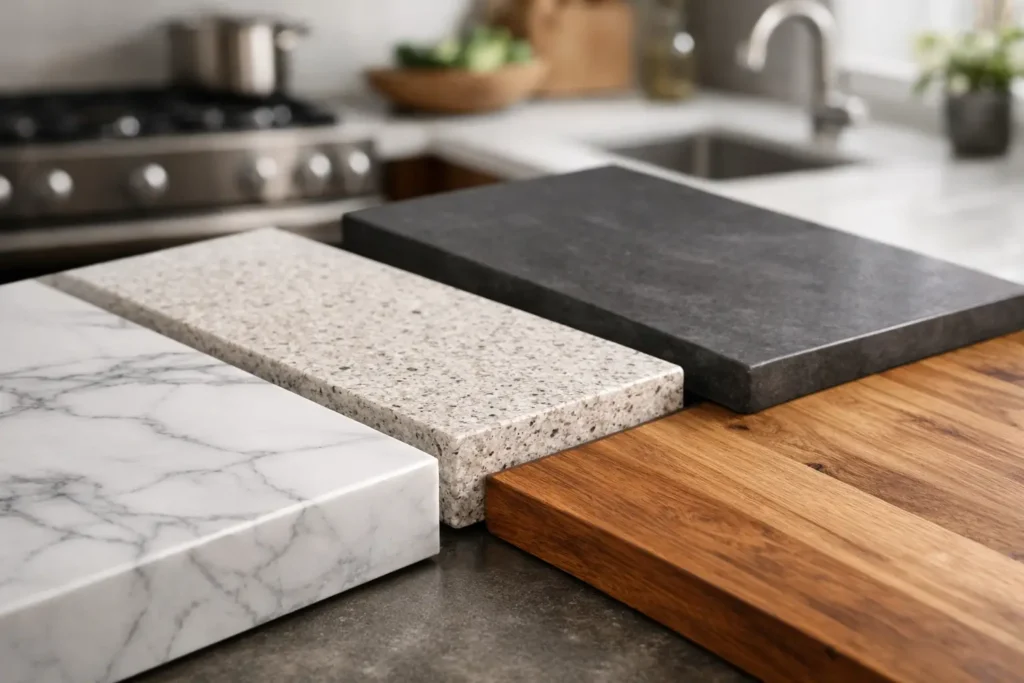
A busy kitchen does not need a countertop that looks perfect only on installation day. It needs a surface that can handle breakfast spills, hot serving dishes, homework, meal prep, grocery bags, and regular cleaning without becoming another household chore. The best countertops for busy kitchens are the ones that fit how your family actually uses the room, not just how they look in a showroom.
For most homeowners, that means balancing durability, maintenance, cost, and installation quality. A beautiful slab can still disappoint if it stains easily, chips at the sink cutout, or requires more upkeep than your schedule allows. Here is a clear look at the materials that hold up best when the kitchen stays in constant use.
What Busy Kitchens Need From a Countertop
The right countertop should make everyday cleanup faster. Nonporous surfaces are especially useful in family kitchens because they resist absorbed spills from coffee, juice, cooking oil, sauces, and raw-food prep. They also reduce the need for frequent sealing and special cleaning products.
Heat resistance matters, but it should not be the only deciding factor. Most countertop materials can be damaged by sudden, extreme heat or thermal shock, so trivets are still a smart habit. Scratch resistance matters too, particularly if you cook often, move small appliances around, or have children using the island for projects.
Finally, consider repairability and edge durability. The most common damage does not usually happen in the center of the countertop. It happens around sink openings, outside corners, seams, and high-traffic island edges. Professional measurement and installation are just as important as the material you select.
Best Countertops for Busy Kitchens: The Top Choices
Quartz: Best Overall for Low-Maintenance Homes
Quartz is often the strongest all-around choice for an active household. It is an engineered surface made with natural quartz minerals and resin binders, creating a dense, nonporous countertop that does not need routine sealing. Most food and drink spills can be wiped up with mild soap, water, and a soft cloth.
Quartz offers consistent color and pattern options, from clean solid shades to designs that resemble marble or natural stone. That makes it easier to match cabinets, backsplashes, sinks, and flooring without worrying about major variation from one slab to another.
The trade-off is heat. Quartz is durable, but it is not a surface for placing hot pans directly from the oven or stove. High heat can discolor or crack the resin components. Use trivets, especially near cooktops and on kitchen islands. Quartz can also be more expensive than entry-level granite or laminate, but its low-maintenance performance often makes it worthwhile for busy families.
Granite: Best for Natural Stone Strength
Granite remains a reliable choice for homeowners who want real stone, strong heat resistance, and a one-of-a-kind appearance. Every slab has natural movement and variation, so no two kitchens will look exactly alike. It handles everyday wear well and can tolerate more heat than quartz, though a trivet is still recommended to prevent stress on the stone.
The main responsibility with granite is sealing. Quality granite should be properly sealed after installation and resealed when needed based on the specific stone and how heavily the kitchen is used. Without proper sealing, lighter or more porous granite can absorb oils, wine, and other stains.
Granite is a good fit if you enjoy the character of natural materials and are willing to handle basic maintenance. It is especially practical for homeowners who cook frequently and want a countertop that can take daily use without looking manufactured.
Porcelain: Best for Heat, Stains, and Modern Style
Porcelain slabs are becoming a serious option for hardworking kitchens. They are highly resistant to heat, stains, UV exposure, and scratching. This makes porcelain particularly useful for kitchens with strong sunlight, outdoor cooking areas, or homeowners who want a clean, modern surface that does not require sealing.
Porcelain can also deliver the look of marble, concrete, metal, or wood with less maintenance than many of those materials. It is a practical choice when the design calls for a dramatic pattern but the household cannot accommodate delicate surfaces.
Installation is where porcelain requires experience. The slabs can be thin and strong, but edges and cutouts must be fabricated correctly to avoid chipping. Not every installer has the tools or skill to work with large-format porcelain. This is not a material to buy first and figure out later. Confirm that the fabrication and installation team is prepared for it.
Solid Surface: Best for Easy Repairs and Integrated Sinks
Solid surface countertops offer a smooth, nonporous finish with nearly invisible seams in many applications. They are easy to clean, do not require sealing, and can be paired with integrated sinks for a continuous surface with no rim where crumbs and grime can collect.
This material is softer than quartz, granite, or porcelain, so it can scratch or dent more easily. The advantage is that many minor scratches and surface marks can be professionally repaired or refinished. For a household that values easy cleanup and a uniform appearance, solid surface is a practical middle-ground option.
It performs best when homeowners are willing to use cutting boards and trivets. If heavy cast-iron cookware, extremely hot pans, and sharp knives regularly hit the counter, quartz or granite may be a better long-term match.
Laminate: Best for Budget-Focused Kitchen Updates
Modern laminate is not the same product many homeowners remember from decades ago. Today’s options can closely imitate stone, wood, and concrete at a significantly lower cost than slab materials. It is easy to clean, available in many colors, and useful for rental properties, starter homes, laundry rooms, or a fast kitchen refresh.
Its limitations are clear: laminate is more vulnerable to heat, scratches, and water damage at seams or edges. A hot pan can burn the surface, and water that reaches the substrate can cause swelling. It is not the top choice for a high-impact family kitchen expected to last for decades, but it can be the right choice when budget and speed are the priority.
A careful installation is critical. Well-finished edges, properly sealed sink areas, and quality seams make a major difference in how laminate performs over time.
Materials That Need More Care
Marble has unmatched natural beauty, but it is rarely the easiest answer for a busy kitchen. It can etch when exposed to acidic foods such as lemon juice, vinegar, and tomato sauce. It can also stain and scratch more easily than quartz, granite, or porcelain. Marble works well for homeowners who accept a lived-in patina, but it can become frustrating for anyone who wants a countertop to stay spotless with minimal effort.
Butcher block brings warmth and can make an island feel less formal, but wood requires regular oiling and prompt attention to water. It can scratch, dent, and darken around sinks. It is often better as an accent surface than as the only countertop in a heavy-use kitchen.
Concrete is durable and customizable, but it needs professional installation and periodic sealing. Hairline cracking and color variation are part of the material’s character. For the right design, it can be a strong choice, but it is not automatically low-maintenance.
Choose Based on How You Use the Kitchen
If your priority is fast cleanup and minimal upkeep, quartz is usually the safest choice. If you want real stone and better heat tolerance, granite is a dependable option with manageable maintenance. If you want top-level heat and stain resistance with a contemporary look, porcelain deserves serious consideration.
For a repair-friendly, smooth surface with integrated sink options, solid surface works well. If cost is the main concern, laminate can deliver a clean update, provided you understand its limitations around heat and moisture.
Do not choose solely from a small sample. Ask to see full slabs or large samples under your kitchen lighting. Check how the material looks beside your cabinet color, backsplash, and flooring. Also think through where you set hot pans, where children sit, and whether your island doubles as a work zone, dining table, or prep station.
Installation Is Part of Countertop Performance
Even the best material can fail early when seams, sink cutouts, supports, and edges are handled poorly. Large overhangs may need brackets or hidden steel supports. Undermount sinks must be secured correctly. Seams should be planned around the layout, slab size, and natural pattern rather than placed wherever they are easiest.
A full-service team can prevent the usual handoff problems between cabinet suppliers, countertop fabricators, plumbers, and installers. Cobo Kitchen Master & Home Repair helps homeowners coordinate the materials and installation work in one place, reducing delays and keeping the project moving.
The best countertop is the one that lets your kitchen work harder without demanding more from you. Choose a surface that fits your daily routine, protect it with simple habits, and make sure the installation is handled with the same care as the material itself.