
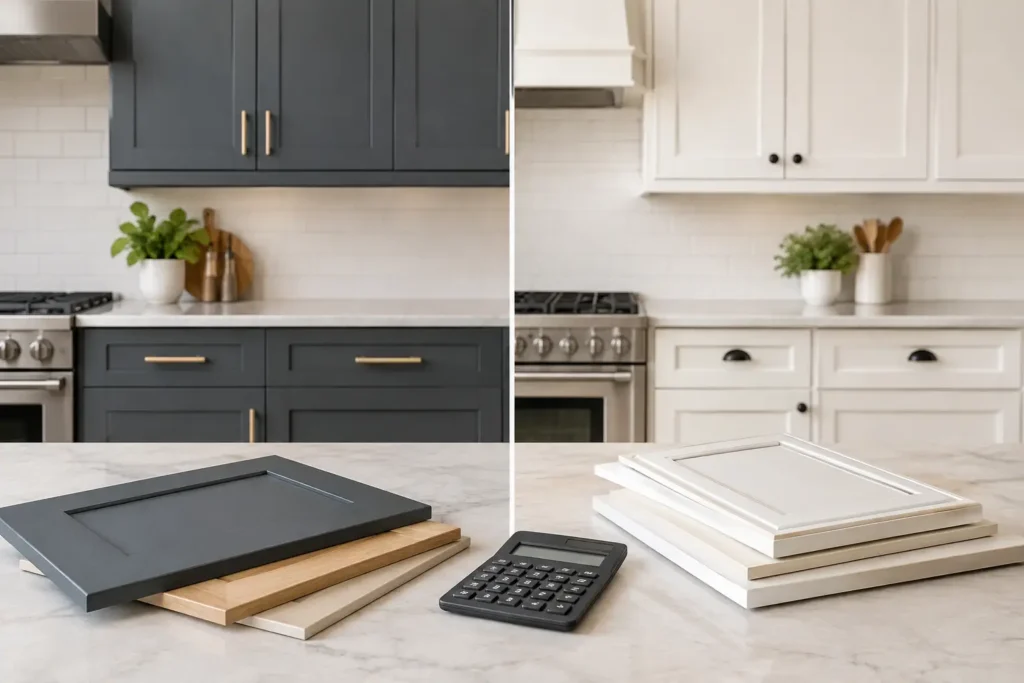
A kitchen can look dated because of worn doors, chipped finishes, or hardware that has seen better days. That does not automatically mean every cabinet needs to come out. The real question behind cabinet refacing versus replacement cost is whether your existing cabinet boxes still deserve to stay or whether they are the problem.
For homeowners who want a clear answer, the lowest upfront price is not always the lowest total cost. Layout changes, water damage, installation labor, countertop removal, and project delays all affect the final number. The right choice depends on the condition of your kitchen, the results you expect, and how long you plan to keep the home.
Cabinet Refacing Versus Replacement Cost: The Basic Difference
Cabinet refacing keeps the existing cabinet boxes in place. The visible parts are updated with new doors, drawer fronts, veneer or finished panels, and usually new hinges and hardware. The cabinet footprint stays the same, but the kitchen gets a new face.
Cabinet replacement removes the existing cabinets and installs new ones. This gives you the freedom to change the layout, add storage, adjust cabinet height, replace poor-quality boxes, or redesign the kitchen around how your household actually uses it.
As a general planning range, professional refacing often costs roughly $4,000 to $10,000 for an average kitchen. Full cabinet replacement commonly starts around $8,000 and can rise well beyond $20,000 depending on cabinet construction, kitchen size, design choices, installation requirements, and whether countertops, plumbing, flooring, or electrical work are involved.
Those ranges are not quotes. A small kitchen with standard materials may fall below them, while a large kitchen with custom features may exceed them. The key difference is simple: refacing pays for a new exterior, while replacement pays for entirely new cabinetry and the labor required to remove, prepare, and install it.
When Refacing Is Worth the Cost
Refacing can be a smart investment when the cabinet boxes are solid, level, dry, and properly attached to the wall. If drawers work well, shelves are in good shape, and the current layout serves your household, there is no reason to pay for demolition just to change the appearance.
It is especially practical when your goal is a fast visual upgrade. New shaker doors, modern pulls, soft-close hinges, and matching end panels can change the entire kitchen without moving plumbing or rebuilding the room around a new cabinet plan.
Refacing also creates less disruption. Since the boxes remain in place, there is less demolition debris and fewer moving parts. That can reduce labor time and make the project easier for busy households, rental-property owners, or anyone who needs the kitchen back in service quickly.
Still, refacing is not a repair for failing cabinets. New doors cannot correct swollen particleboard, loose cabinet boxes, sagging shelves, or years of moisture damage under the sink. Covering those problems may look good for a short time, but it does not create a durable kitchen.
The limits of refacing
Refacing does not meaningfully change your kitchen layout. You may be able to add a few accessories or replace select pieces, but you cannot create more floor space, move the sink easily, or solve a cramped work triangle without more extensive work.
It also has a price ceiling. If you select premium door styles, specialty finishes, substantial modifications, and upgraded hardware, refacing can get close to the cost of entry-level new cabinets. At that point, comparing both options is necessary. Paying nearly replacement-level pricing while keeping old boxes may not deliver the best value.
When Cabinet Replacement Makes More Sense
Replacement is the right call when the structure is compromised or the kitchen no longer works for your family. This is common in older kitchens with water damage, poorly installed cabinets, worn drawer systems, limited storage, or cabinets that were built for a different way of living.
New cabinets make it possible to add deeper drawers, pull-out storage, a pantry cabinet, better corner solutions, trash pullouts, and cabinets sized for current appliances. If you are already changing countertops, relocating plumbing, or opening walls, starting with new cabinetry often prevents patchwork decisions later.
Replacement also gives you a cleaner path when cabinet sizes are unusual. Older homes sometimes have cabinets that are out of square, too shallow, or difficult to match. Instead of forcing a new finish onto a poor foundation, new cabinets allow the installation team to correct the room and build a more functional result.
The trade-off is cost and coordination. Cabinet removal can expose drywall damage, uneven floors, old plumbing connections, or electrical issues that need attention before installation. Countertops often need to be removed and replaced as well, especially if the new cabinet footprint or height changes. These are valid reasons replacement costs more, not surprise add-ons to ignore during planning.
The Costs Homeowners Miss
A cabinet proposal is only useful if it shows what is included. Comparing one price against another without matching the scope can lead to the wrong decision.
With refacing, ask whether the estimate includes new doors and drawer fronts, cabinet-box finishing, end panels, crown molding, hardware, hinge upgrades, drawer-front adjustments, and installation. A lower number may leave out finish work that is needed for the kitchen to look complete.
With replacement, confirm the cost of removing old cabinets, disposal, delivery, assembly, installation, fillers, trim, toe kicks, hardware, and any modifications needed for appliances. If plumbing must be disconnected and reconnected for a sink base, that should be discussed before work begins. The same applies to electrical outlets, under-cabinet lighting, drywall repair, flooring transitions, backsplash, and countertop installation.
Countertops deserve special attention. If your current countertop is in excellent condition and the cabinet layout will not change, it may sometimes be possible to work around it. In many replacement projects, however, countertop removal is part of doing the job correctly. Reusing an old countertop can risk cracks, poor fit, or an unfinished appearance.
Compare Value, Not Just the First Number
The best option is the one that solves the right problem for the right amount of time. Refacing may offer strong value if you plan to stay in the home several years, like the layout, and have cabinet boxes worth keeping. It can provide a clean, updated kitchen without the cost and disruption of a full rebuild.
Replacement generally offers better long-term value when you need improved storage, a new layout, dependable cabinet construction, or a kitchen that supports a larger renovation. It is also the better choice when repairs would keep piling up around old cabinets. Replacing weak boxes once can cost less than refacing, repairing, and replacing them in stages.
For resale, both options can improve appeal when the work is professionally planned and installed. Buyers notice cabinet condition, functionality, and overall finish quality. A refaced kitchen can make a strong impression when the cabinets are solid. A new cabinet installation is more compelling when the old kitchen had obvious layout or condition problems.
A Straightforward Way to Decide
Start by opening every cabinet and drawer. Check under the sink, at the cabinet bottoms near the dishwasher, and along the wall where boxes meet each other. Look for swelling, soft spots, mildew, broken drawer slides, loose screws, peeling interiors, or cabinets that are no longer level.
Then consider how you use the room. If you constantly run out of storage, cannot fit modern appliances comfortably, or need to move the sink or range, replacement is usually the more honest solution. If the room works well and the boxes are solid, refacing may be the faster, more cost-controlled upgrade.
Finally, ask for a detailed scope that separates materials, installation, and related repairs. A dependable contractor should explain what can be saved, what should be replaced, and what could affect the schedule before the work starts. Cobo Kitchen Master & Home Repair can help homeowners evaluate cabinet condition, select in-stock options, and coordinate the installation work under one team.
Do not let a dated finish push you into a full replacement, and do not let a low refacing price hide structural problems. Choose the option that gives your kitchen a finished look, dependable function, and a result you will not need to redo in a few years.