
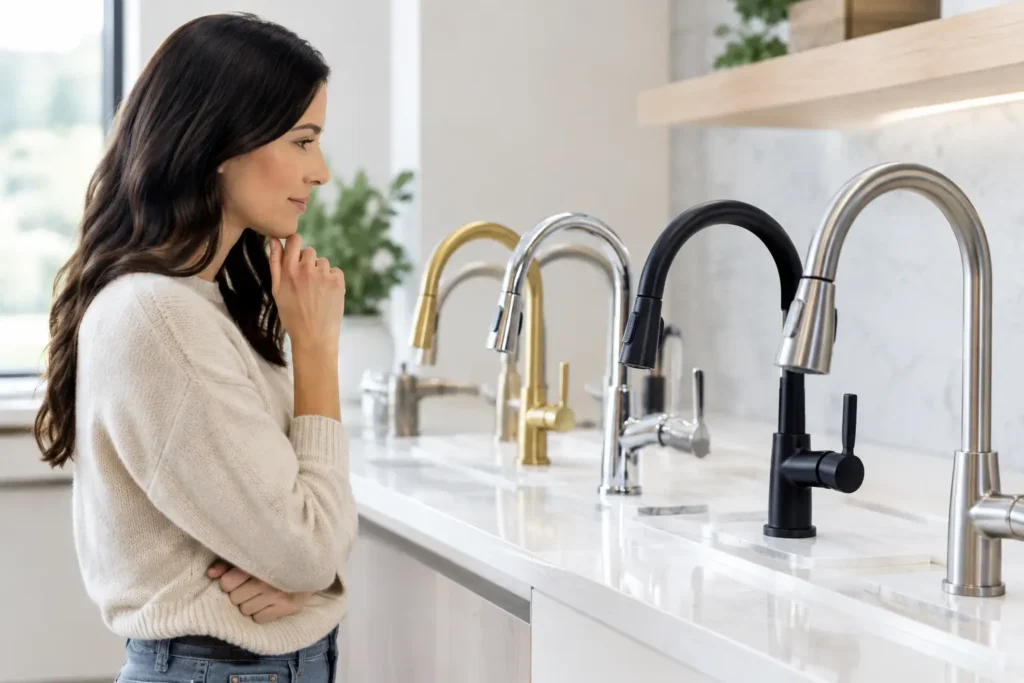
A kitchen faucet gets used more than almost any other fixture in the house. It fills pots, rinses dishes, cleans produce, and handles the mess after dinner. Knowing how to select the right kitchen faucet means choosing more than a finish that looks good. The faucet has to fit your sink, your countertop, your plumbing, and the way your household actually uses the kitchen.
A faucet that looks right but splashes across the counter, cannot reach the corners of the sink, or fails after a short time is not a good value. Start with the practical details first. Then choose the style that completes the room.
How to Select the Right Kitchen Faucet: Start With Fit
Before shopping by style, measure the sink area and inspect the existing faucet setup. This avoids a common renovation problem: buying a new fixture that does not match the holes in the countertop or sink.
Count the mounting holes. Many modern kitchen faucets need one hole, while older configurations may use three or four. A single-handle faucet can often be installed on a three-hole sink with a matching deck plate, but not every model includes one. If the extra holes will remain exposed, the finished kitchen can look incomplete.
Also check the space behind the sink. A faucet with a large handle movement or a pull-down hose needs clearance from the backsplash and wall. If you are installing a window behind the sink, measure the height carefully. A high-arc model may be functional, but it cannot interfere with opening the window.
The faucet’s spout reach matters as much as its height. The water stream should land near the center of the sink bowl, not against the back wall or directly on the drain. For a wide single-bowl sink, a short-reach faucet can leave you stretching to rinse large cookware. For a compact sink, an oversized commercial-style faucet can feel crowded and create more splash.
Choose the Faucet Type for Daily Use
There is no single best faucet for every kitchen. The right choice depends on who uses it, how often meals are prepared, and how much cleaning happens at the sink.
Single-handle faucets
Single-handle faucets are the most common choice for busy kitchens. One lever controls both water temperature and flow, making it easy to operate with one hand. They suit family kitchens, rental properties, and homeowners who want a straightforward, reliable setup.
The trade-off is less precise temperature adjustment than some two-handle designs. Still, quality single-handle models with ceramic disc cartridges perform well and are easier to use when your hands are full.
Two-handle faucets
Two-handle faucets give separate control over hot and cold water and can support a more traditional kitchen design. They usually require more mounting holes and take a little longer to adjust to the right temperature. They are a solid option when the sink and countertop are already configured for them, especially in classic or period-inspired kitchens.
Pull-down and pull-out sprayers
A pull-down faucet has a tall spout with a spray head that pulls straight down into the sink. It works especially well with deep, single-bowl sinks and makes rinsing large pans easier. Pull-out faucets have a shorter spout and a spray head that pulls toward you. They can be a better fit below low cabinets or windows.
For most active kitchens, a pull-down sprayer offers the best combination of reach and convenience. Look for a secure docking system and a hose that retracts smoothly. A weak magnet or poor hose weight can leave the spray head hanging loose over time.
Touch and touchless faucets
Touch-activated and touchless faucets help reduce mess when hands are covered with raw food or dough. They are convenient, but they also add electronic components, batteries, or an under-sink power connection. Choose this option when convenience is worth the added complexity and the installation has room for the control box.
For homeowners focused on simple maintenance and dependable operation, a standard manual faucet remains a strong choice. More features are not always better if they do not solve a real need in your kitchen.
Match the Faucet to the Sink
Your sink and faucet should work as one system. A deep farmhouse sink usually needs a faucet with enough height and reach to clear tall stockpots and cover the full bowl. A double-bowl sink benefits from a swiveling spout or pull-down sprayer that can move easily between both sides.
Pay attention to splash. High-arc faucets are useful, but a tall faucet paired with a shallow sink can send water onto surrounding counters. This is especially common when the water pressure is high. In that situation, a lower arc, shorter reach, or adjustable flow setting may be the smarter choice.
If you are replacing the sink during a kitchen renovation, choose both fixtures together. That lets the installer confirm hole placement, clearances, drainage, and countertop compatibility before anything is cut or mounted.
Check Water Pressure and Plumbing Connections
A beautiful faucet cannot overcome plumbing problems. If your current faucet has weak flow, inconsistent temperature, leaks under the sink, or noisy pipes, address those issues before installing a replacement fixture.
Most residential kitchen faucets are designed for standard water pressure, but performance varies by model. A faucet with a low flow rate may conserve water, yet it can feel slow when filling a large pot. A high-performing spray pattern can make cleanup faster without wasting water, so review both the gallons-per-minute rating and the available spray settings.
Under the sink, confirm that the shutoff valves are working and that supply lines are in good condition. Old valves may fail when they are turned during installation. Corroded fittings, limited cabinet space, or a garbage disposal can also make a simple faucet swap more involved than expected.
A professional installation is the right call when plumbing needs repair, the countertop requires new holes, or the faucet includes electronic controls. It protects the new fixture and helps prevent the slow under-sink leaks that can damage cabinets before anyone notices.
Select a Finish That Works Beyond Day One
Finish should support the kitchen’s overall look, but it also affects cleaning and how quickly everyday marks show up. Brushed nickel and stainless finishes are practical choices because they blend with many appliances and hide water spots better than highly polished surfaces. Matte black creates a strong, modern contrast but may show mineral deposits in areas with hard water.
Chrome is durable, widely available, and easy to match, though it shows fingerprints and water spots more readily. Warm finishes such as champagne bronze or brushed gold can add character, but matching them with cabinet hardware, lighting, and appliance accents takes more planning.
You do not need every metal in the kitchen to match exactly. You do need the combination to look intentional. If the faucet will be the dominant metal feature, choose a finish that works with the cabinet pulls and nearby lighting rather than treating it as an isolated purchase.
Prioritize Parts That Hold Up
The internal components matter more than an impressive-looking handle. Choose a faucet with a ceramic disc cartridge. These cartridges are built to reduce drips and tend to last longer than older compression-style mechanisms.
Look for solid construction, durable hose connections, and replacement parts that can be serviced later. Plastic components are not automatically a problem, but heavily used moving parts should feel secure and operate smoothly. Test the handle, spray button, and docking action in person when possible.
A lower-priced faucet can make sense for a lightly used rental or temporary update. For a primary kitchen, paying for better valves, stronger mounting hardware, and dependable parts availability usually costs less than replacing a failed faucet in a few years.
Plan Installation Before You Buy
The faucet is one of the final details that makes a kitchen usable, so do not leave it to guesswork. Confirm the hole configuration, faucet height, spout reach, cabinet clearance, and supply line condition before the fixture arrives. If you are adding a water filter, soap dispenser, air gap, or instant hot-water dispenser, plan every countertop hole at the same time.
This is where one company handling the materials, installation, and plumbing work saves time. Instead of waiting for separate suppliers and contractors to coordinate, the project can move from selection to installation with fewer surprises.
The right kitchen faucet should make daily work easier, not become another repair on your list. Choose a fixture that fits the sink, supports your routine, and is installed correctly from the start. Cobo Kitchen Master & Home Repair can help homeowners match the right faucet to the right kitchen and complete the installation with dependable workmanship.