
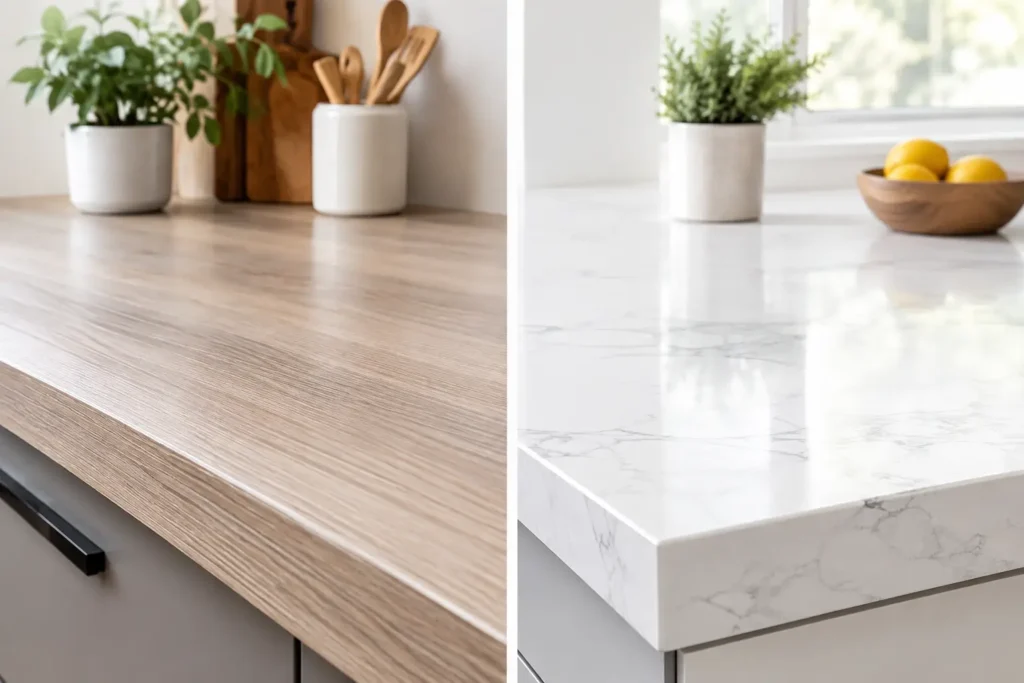
A countertop choice can change the entire direction of a kitchen remodel. When comparing laminate versus quartz countertops, the right answer is not simply about appearance. It comes down to budget, how your household uses the kitchen, the condition of your cabinets, and how quickly you need the job finished.
Laminate gives homeowners a practical, lower-cost surface with more design options than many people expect. Quartz delivers a heavier, more premium surface built for long-term durability. Both can work well. The key is choosing the material that fits your project instead of paying for features you will not use or settling for a surface that cannot handle your routine.
Laminate versus quartz countertops: the main difference
Laminate countertops are made from a decorative high-pressure surface bonded to a wood-based core. Modern laminate can convincingly resemble stone, concrete, wood, or solid colors. It is lightweight, available in many patterns, and usually quicker and less expensive to install than stone.
Quartz countertops are engineered stone. They combine natural quartz particles with resins and pigments, creating a dense, nonporous slab with consistent color and pattern options. Quartz has the substantial feel and clean finish many homeowners want in an upgraded kitchen, but it requires a larger material and installation investment.
Neither material is automatically better. A rental turnover, a first kitchen refresh, and a high-use family kitchen may call for different decisions.
Cost: upfront price and long-term value
Laminate is usually the clear winner for immediate budget control. Material and installation costs are generally lower, especially for straightforward countertop runs. This makes laminate a strong choice when cabinets are being refreshed, a property needs to be ready quickly, or you want to invest more of the budget in plumbing, appliances, flooring, or cabinet upgrades.
Quartz costs more because of the slab material, fabrication, transport, and specialized installation. Seams, cutouts, edge profiles, backsplash pieces, and sink openings can also affect the final price. It is a long-term surface, but homeowners should compare complete project quotes rather than only looking at a per-square-foot estimate.
The best value depends on the home. If you plan to stay for years and want a durable, upscale finish, quartz can justify the higher spend. If your goal is a clean, attractive kitchen without stretching the renovation budget, laminate can deliver a strong result.
Daily durability: heat, scratches, and water
Quartz is harder and more resistant to scratches than laminate under normal kitchen use. It holds up well against routine meal prep, spills, and busy family traffic. Because it is nonporous, it does not need sealing, and common kitchen messes are less likely to penetrate the surface.
That does not mean quartz is indestructible. Do not place hot pans directly on it. Sudden, concentrated heat can damage the resin or cause cracking. Avoid cutting directly on quartz as well. A cutting board and a trivet are still part of proper countertop care.
Laminate handles everyday use well, but it is more vulnerable to sharp blades, prolonged moisture, and high heat. A hot pot can scorch or blister the surface. Water that repeatedly gets into a seam, edge, or damaged area can swell the core underneath. This matters most around the sink, dishwasher, and countertop joints.
For a household that cooks constantly, has children, or uses the kitchen as the center of daily activity, quartz usually offers more margin for error. For a lightly used kitchen or a budget-conscious remodel, laminate remains a dependable option when it is installed correctly and treated with basic care.
What happens when damage occurs
Minor laminate damage may be less expensive to address, but deep cuts, burns, chips, or swollen areas are difficult to make disappear. In many cases, replacing a section or the full countertop is the cleaner solution.
Quartz resists damage well, but chips can happen at edges and around sink cutouts. Small repairs are often possible with color-matched materials, depending on the damage and slab pattern. A major crack or break is more serious and can be costly to repair. Both materials benefit from professional installation that supports the countertop properly and protects vulnerable areas.
Appearance and design options
Laminate has changed considerably from the thin, dated patterns many homeowners remember. It now comes in marble-look, granite-look, textured, matte, and solid-color designs. It can create a coordinated kitchen quickly, particularly when paired with in-stock cabinets, a new sink, and updated hardware.
Its limitation is depth. Even high-quality laminate does not have the natural thickness or visual movement of a stone slab when viewed up close. Edge treatments can improve the finished appearance, but the countertop will still read as laminate in many designs.
Quartz has a more substantial look and can support a wide range of styles, from clean white surfaces to bold veining and darker modern finishes. It works especially well with undermount sinks, which create a smooth transition from counter to sink and make cleanup easier. Large islands also benefit from quartz because the material creates a more continuous, high-end surface.
If your kitchen needs to look polished for resale or you want the countertop to be a central design feature, quartz often has the advantage. If you want a well-coordinated update without making the counter the most expensive part of the project, laminate offers more flexibility.
Installation affects the final result
Countertop material is only half the decision. Measurements, cabinet level, seam placement, sink fit, and wall conditions determine whether the finished kitchen looks clean and performs properly.
Laminate is lighter and generally easier to handle than quartz. That can support a faster installation timeline, particularly for standard layouts. Still, it needs accurate cuts, properly sealed seams, and careful sink installation. A poorly sealed sink opening is one of the fastest ways to shorten the life of a laminate counter.
Quartz is heavy and must be measured, fabricated, transported, and installed by experienced professionals. Cabinets need to be level and structurally sound before a slab is set. The installation team also needs to plan seam locations and support areas around cooktops, sinks, and overhangs.
At Cobo Kitchen Master & Home Repair, homeowners can simplify this process by working with one team for cabinets, countertops, sinks, faucets, installation, and related repairs. When materials are in stock and the installer is already coordinating the work, there are fewer handoffs and fewer delays.
When laminate is the smarter choice
Choose laminate when the project needs to move quickly, the budget has firm limits, or the home does not need a premium stone surface. It is often the practical answer for rental properties, starter homes, secondary kitchens, laundry rooms, and cosmetic upgrades before a sale.
Laminate also makes sense when existing cabinets are in good shape but the old countertop is worn, stained, or outdated. A new laminate surface, sink, faucet, and backsplash can make the room feel significantly newer without turning the project into a full structural remodel.
The important point is not to treat laminate as a shortcut. Choose a quality pattern, use an experienced installer, and protect the countertop from heat and standing water. Done right, it can serve a kitchen well for years.
When quartz is worth the investment
Quartz is usually the better fit when you want a long-lasting, low-maintenance countertop with a more upscale finish. It is well suited to busy family kitchens, homes where entertaining is common, and kitchen remodels that include new cabinets and upgraded fixtures.
It is also a strong choice when you want an undermount sink or a large island that becomes the work center of the room. The nonporous surface makes daily cleanup simple, and its consistency can help create a polished look across countertops, islands, and matching backsplash areas.
Before committing, make sure the rest of the kitchen supports the investment. If cabinets are loose, uneven, water-damaged, or nearing the end of their life, correct those issues first. Installing a heavy quartz slab over failing cabinets is not a lasting repair.
Make the choice based on how you live
The real question is not whether laminate or quartz is the best countertop material overall. It is which one solves your problem without creating a new one. Laminate keeps costs controlled and gets a kitchen looking fresh fast. Quartz provides durability, a premium appearance, and easier everyday maintenance at a higher initial cost.
Start with the condition of your cabinets, your available budget, and the way your kitchen is used every week. Then choose the countertop that lets you finish the project properly, with professional measurements, solid installation, and no unnecessary delays.