
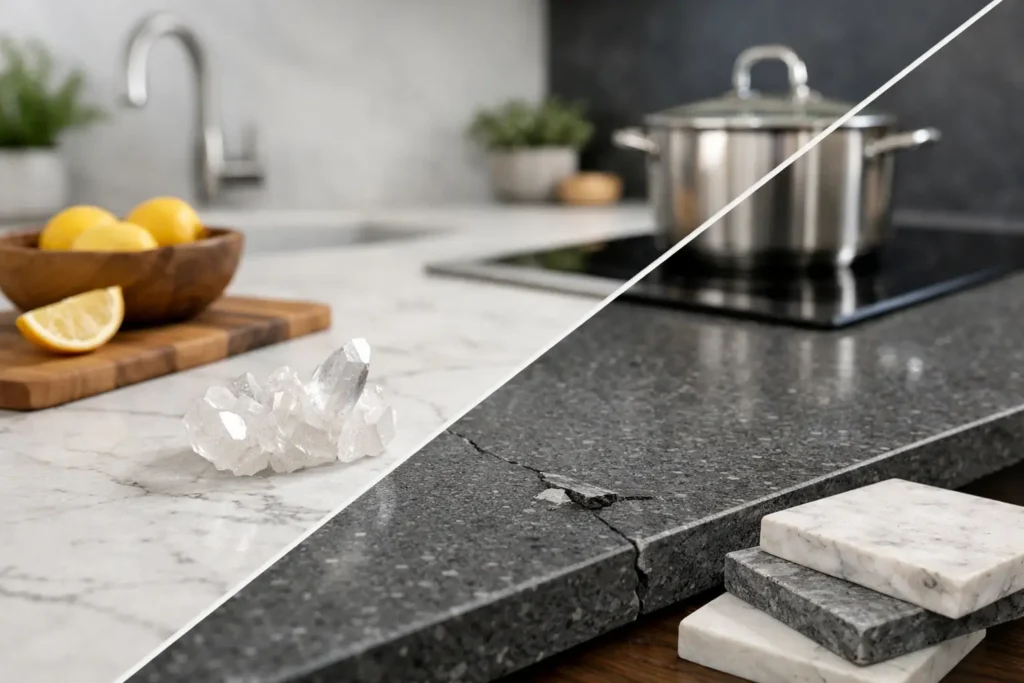
If you’re replacing kitchen counters, the decision usually gets real when you start comparing daily wear, cleanup, price, and installation time. That is where quartz countertop pros and cons matter most. A surface can look great in a showroom and still be the wrong fit for the way your household actually cooks, cleans, and uses the space.
Quartz has become one of the most requested countertop materials for a reason. It offers a clean, consistent look, strong day-to-day durability, and lower maintenance than many natural stone options. But it is not the automatic winner for every kitchen or every budget. The right choice depends on how hard you use your counters, the look you want, and whether you care more about low upkeep or natural variation.
Quartz countertop pros and cons at a glance
Quartz is an engineered surface made from crushed quartz minerals combined with resins and pigments. That manufacturing process gives it a more uniform appearance than granite or marble, and it also helps create a non-porous surface.
The main advantages are easy maintenance, strong stain resistance, and a wide range of colors and patterns. The main drawbacks are cost, sensitivity to high heat, and less natural character than some homeowners want. Those trade-offs are manageable for many households, but they should be understood before installation starts.
The biggest advantages of quartz countertops
For busy homes, quartz solves several common problems at once. It gives you a polished, finished look without demanding a lot of upkeep after installation.
Low maintenance is the strongest selling point
This is the reason many homeowners choose quartz over natural stone. Quartz does not require sealing, and routine cleaning is simple. In most kitchens, mild soap and water are enough for daily cleanup.
That matters more than people think. A countertop may look like a design decision, but in real life it is a work surface. If you want something that looks good without adding another maintenance task to your schedule, quartz is hard to ignore.
Strong stain resistance
Because quartz is non-porous, it resists common kitchen stains better than many other surfaces. Coffee, wine, oil, sauce, and juice are less likely to soak in when spills are cleaned up in a reasonable amount of time.
For family kitchens, rental properties, and households that cook often, that is a practical benefit. You do not have to worry as much about every splash turning into a permanent problem.
Consistent appearance
Natural stone has variation. Some homeowners love that. Others want to know exactly what they are getting. Quartz gives you more control over the final look because the pattern and color are engineered.
That consistency helps when you are trying to match cabinets, backsplash tile, and flooring without surprises. It is especially useful in modern kitchens where a cleaner, more uniform finish works better than dramatic movement in the slab.
Good durability for daily use
Quartz handles normal kitchen use well. It stands up to scratches better than many laminate surfaces and performs reliably in active households. For food prep, homework, serving meals, and everyday traffic, it is a strong all-around performer.
That does not mean it is indestructible. No countertop is. But for regular use, quartz holds up well when installed correctly and treated with basic care.
The main downsides homeowners should know
Quartz has clear benefits, but a good contractor should also tell you where it falls short. That is how you avoid buying the right material for the wrong expectations.
Heat can be a problem
Quartz is not the best surface for direct high heat. The resins that help bind the material can be damaged by hot pots, hot pans, or countertop appliances that generate concentrated heat over time.
This is one of the most important quartz countertop pros and cons to understand before you commit. If you regularly move cookware straight from the stove or oven to the counter, you will need to use trivets or pads consistently. Homeowners who know they will not do that should think carefully.
It can be expensive
Quartz is not usually a budget countertop. Depending on the brand, color, edge profile, and installation complexity, the final cost can be similar to or higher than some granite options.
Price also depends on the layout. Large kitchens, waterfall edges, full-height backsplashes, and oversized islands increase material and labor costs. If your renovation budget is tight, quartz may still be worth it, but it should be priced honestly against other choices.
It is heavy and installation matters
Quartz is a dense, heavy material that needs proper support and professional installation. This is not a product where cutting corners usually ends well.
Bad measurements, weak cabinet support, poor seams, or careless handling can turn a premium countertop into a headache. That is why homeowners benefit from working with one company that can supply the product, check the cabinets, and handle the installation without finger-pointing between trades.
The look is not for everyone
Quartz offers a lot of styles, including options that mimic marble and concrete, but some homeowners still feel it looks more manufactured than natural stone. If you want unique veining, depth, and movement that no other slab will have, granite or marble may feel more authentic.
This is mostly about preference. There is no wrong answer here, but there is a difference between liking quartz in photos and liking it in your own kitchen every day.
How quartz compares to other countertop options
A practical choice becomes easier when you compare materials based on real use, not just appearance.
Quartz vs. granite
Quartz is generally easier to maintain because it does not need sealing and offers more consistent patterning. Granite brings natural beauty and better heat resistance, but it usually requires more care over time.
If your priority is low maintenance and predictable color, quartz often wins. If your priority is natural variation and heat tolerance, granite may be the better fit.
Quartz vs. laminate
Laminate is usually more affordable upfront, but it does not offer the same durability, resale appeal, or premium feel. Quartz costs more, yet it tends to deliver better long-term performance in kitchens that get heavy use.
For a quick, budget-driven update, laminate can make sense. For a more durable upgrade that adds value and visual impact, quartz is the stronger option.
Quartz vs. marble
Marble has a classic high-end look, but it is softer, more porous, and more likely to etch or stain. Quartz gives you a cleaner maintenance profile and often a similar visual effect with fewer worries.
For homeowners who love the marble look but not the upkeep, quartz is often the practical compromise.
When quartz is a smart choice
Quartz makes the most sense for homeowners who want a reliable, attractive surface without a lot of ongoing maintenance. It works well in busy kitchens, family homes, and properties where ease of care matters as much as appearance.
It is also a strong option when speed matters. If you are trying to keep a remodel moving, material availability and coordinated installation can make a major difference. A good-looking countertop does not help much if the project is stalled for weeks waiting on suppliers or separate trades to line up.
When quartz may not be the best fit
If you cook heavily and place hot pans on the counter without thinking twice, quartz may frustrate you. If you want the exact individuality of natural stone, it may feel too controlled. And if your renovation budget is already stretched thin, there may be better places to spend.
That does not mean quartz is a bad product. It just means the best countertop is the one that fits your actual habits, not the one with the strongest showroom trend.
What to ask before you buy
Before choosing quartz, ask about slab availability, edge options, seam placement, support requirements, and who is responsible for templating and installation. Those details affect both the appearance and the timeline.
It also helps to ask how the countertop will work with your existing cabinets or your new cabinet layout. A countertop is not a standalone purchase. It has to fit the full kitchen correctly. That is one reason many homeowners prefer working with a company that can handle materials and installation under one roof, instead of piecing the job together across multiple vendors.
At Cobo Kitchen Master & Home Repair, that kind of coordination matters because delays usually start when no one owns the full job.
The real decision behind quartz countertop pros and cons
Most homeowners are not just choosing a slab. They are choosing how much upkeep they want, how durable the surface needs to be, how fast the project can move, and how confident they feel in the installation. Quartz performs well when you want a polished, dependable countertop that works hard without demanding much back.
If that sounds like your kitchen, quartz is worth serious consideration. Choose it with clear expectations, make sure the installation is handled right, and you are far more likely to end up with a countertop that still makes sense long after the renovation is done.