
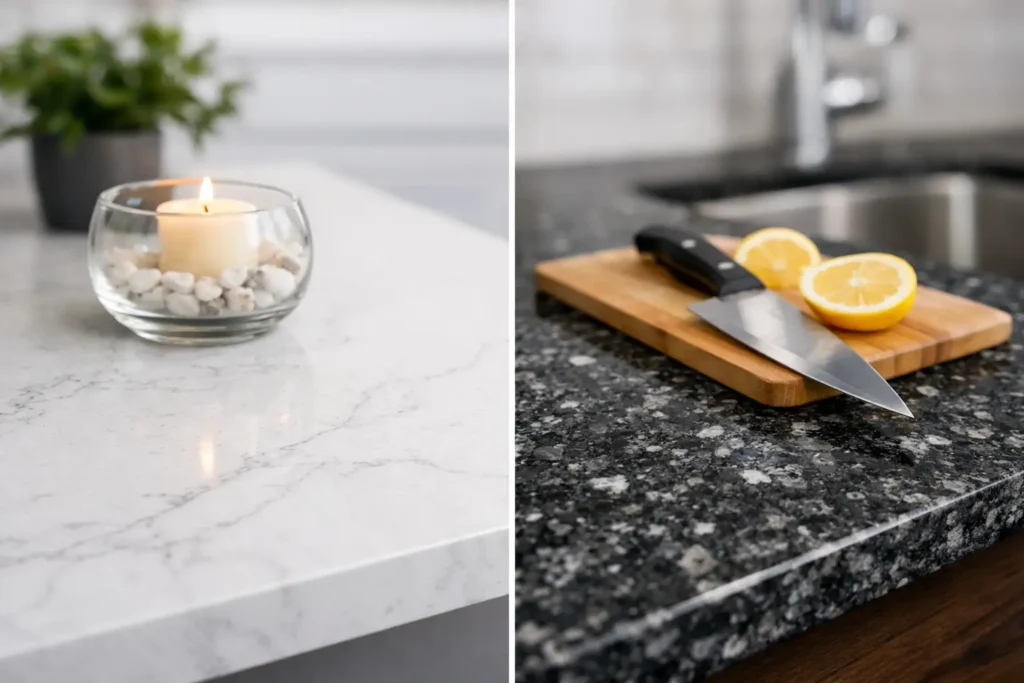
If you are weighing quartz vs granite countertops, you are probably trying to avoid an expensive mistake. Both materials can look great, hold up for years, and add value to a kitchen. The real difference shows up in daily use, maintenance, installation, and how fast you want the job done.
Homeowners usually start with appearance, but that is rarely the deciding factor once the project gets real. The better question is simple: which surface fits the way your household actually cooks, cleans, and lives?
Quartz vs Granite Countertops: The Core Difference
Granite is a natural stone cut from slabs formed in the earth. Every piece has its own movement, mineral pattern, and color variation. That natural look is exactly why many homeowners still choose it.
Quartz countertops are engineered from ground quartz mixed with resins and pigments. They are designed to give you a controlled appearance and a non-porous surface. That manufacturing process makes quartz more consistent from slab to slab, which matters if you want a cleaner, more uniform design.
Neither option is automatically better. One gives you natural variation. The other gives you predictability and lower maintenance. For most kitchens, the right choice comes down to what you want to deal with after installation.
Appearance: Natural Character vs Controlled Design
Granite has depth that is hard to copy. Veining, speckling, and mineral shifts create a one-of-a-kind surface. If you like the idea that no one else will have the exact same countertop, granite has a clear advantage.
Quartz gives you more control. If you want a bright white kitchen, a soft marble look, or a consistent modern finish without heavy variation, quartz is often the easier path. It works especially well in kitchens where cabinets, backsplash, and flooring already have a lot going on.
This is one of those areas where taste matters more than specs. Granite usually appeals to homeowners who want a natural stone statement. Quartz usually appeals to homeowners who want a clean, polished result with fewer surprises.
What looks better in a busy kitchen?
In family kitchens, quartz often feels visually calmer because patterns are more controlled. Granite can hide crumbs, water spots, and minor mess better depending on the color and movement. Lighter quartz shows more of the everyday mess, while darker polished granite can show fingerprints. There is no universal winner here. Sample selection matters as much as the material itself.
Durability in Real Life
Both quartz and granite are durable enough for normal kitchen use, but they do not fail in the same way.
Granite is very hard and handles heat better. A hot pot set down briefly is less likely to cause damage, though using trivets is still the safer habit. Because it is natural stone, it can also be more resistant to scratching under typical kitchen use.
Quartz is also strong, but it is not as heat-tolerant because of the resin content. Direct heat can discolor or damage the surface. If your kitchen runs hot and fast, and people are used to setting pans down without thinking, that matters.
On the other hand, quartz has an advantage in stain resistance because it is non-porous. Granite can stain if it is not properly sealed or if spills sit too long. Wine, oil, coffee, and sauces can become a problem on neglected granite.
So if your concern is heat, granite usually has the edge. If your concern is stains and routine cleanup, quartz usually makes life easier.
Maintenance: This Is Where Many Homeowners Decide
Quartz is easier to maintain. It does not need sealing, and routine cleaning is straightforward with mild soap and water. For homeowners who want a countertop they can install and move on from, quartz is attractive for one reason: less upkeep.
Granite needs more attention. Not constant attention, but real attention. It should be sealed on a schedule based on the stone and how heavily the kitchen is used. Some granite holds up well for longer periods, while some needs more regular care. If sealing gets skipped, the risk of staining goes up.
That does not make granite impractical. It just means granite asks a little more from the homeowner. Some people do not mind that at all. Others know from the start that if a surface needs extra maintenance, it probably will not get it.
Which is better for rentals or investment properties?
For many rentals and investment homes, quartz is the simpler choice because upkeep is easier to control. There is less dependence on the occupant following a maintenance routine. Granite can still work well, but only if you are comfortable with the possibility of missed care over time.
Cost: Material Price Is Not the Whole Story
Quartz and granite often overlap in price, which surprises many homeowners. The idea that one is always budget and the other is always premium is not accurate. Prices vary by color, pattern, thickness, edge profile, and installation complexity.
Some high-end granite slabs cost more than many quartz options. Some designer quartz products cost more than standard granite. The final number also depends on cutouts, sink configuration, backsplash details, and whether old countertops need to be removed.
What matters more than the sticker price is project efficiency. Delays in material availability, templating, fabrication, or installation can cost time and money fast. That is why it helps to work with a company that can supply materials and handle installation under one roof. Fewer handoffs usually means fewer delays and fewer mistakes.
Installation Matters More Than People Think
A good material can still become a bad countertop if the installation is sloppy. Poor seam placement, uneven support, weak cutouts, and rushed finishing create problems that homeowners end up living with for years.
Quartz and granite both need proper measurement, fabrication, transport, and installation. Granite can be more unpredictable because natural slabs vary. Quartz offers consistency, but that does not remove the need for skilled handling.
This is where experience matters. A fast turnaround is only valuable if the work is done right. Cobo Kitchen Master & Home Repair focuses on exactly that balance – in-stock materials, professional installation, and no unnecessary waiting around for separate suppliers and crews to get on the same page.
Which Countertop Is Better for Your Kitchen?
If you want the most low-maintenance option, quartz is usually the better fit. It works well for busy households, rental properties, and homeowners who want a clean look without worrying about sealing.
If you want a natural surface with unique character and stronger heat resistance, granite is still a strong choice. It is especially appealing if you value real stone and do not mind routine maintenance.
If your kitchen gets heavy daily use from a big family, quartz often wins on convenience. If you cook often with hot pans, want a more organic look, and appreciate natural stone variation, granite may be worth the extra care.
If resale is part of the conversation, both materials can support home value when the selection and installation are done well. Buyers respond to quality. They also notice when countertops look dated, poorly fitted, or mismatched with the rest of the kitchen.
Common Mistakes to Avoid When Comparing Quartz vs Granite Countertops
The biggest mistake is choosing based on a small sample alone. A sample may show color, but it does not always show movement, pattern spread, or how the slab will look across a full kitchen. Always think beyond the showroom piece.
Another mistake is focusing only on material cost and ignoring the install process. A lower-priced slab loses its value fast if the project drags out or the workmanship is poor.
The last mistake is being honest about your habits too late. If you know your household will not keep up with sealing, do not pick granite because you like the idea of it. If you know people set hot cookware down without thinking, do not ignore quartz heat limits. The best countertop is the one that fits real life, not ideal behavior.
When you are deciding between quartz and granite, you are not just picking a surface. You are choosing how much maintenance you want, how your kitchen will function, and how smoothly the project will move from selection to installation. Pick the material that matches the way your home actually runs, and you will be happier with it long after the remodel is finished.