
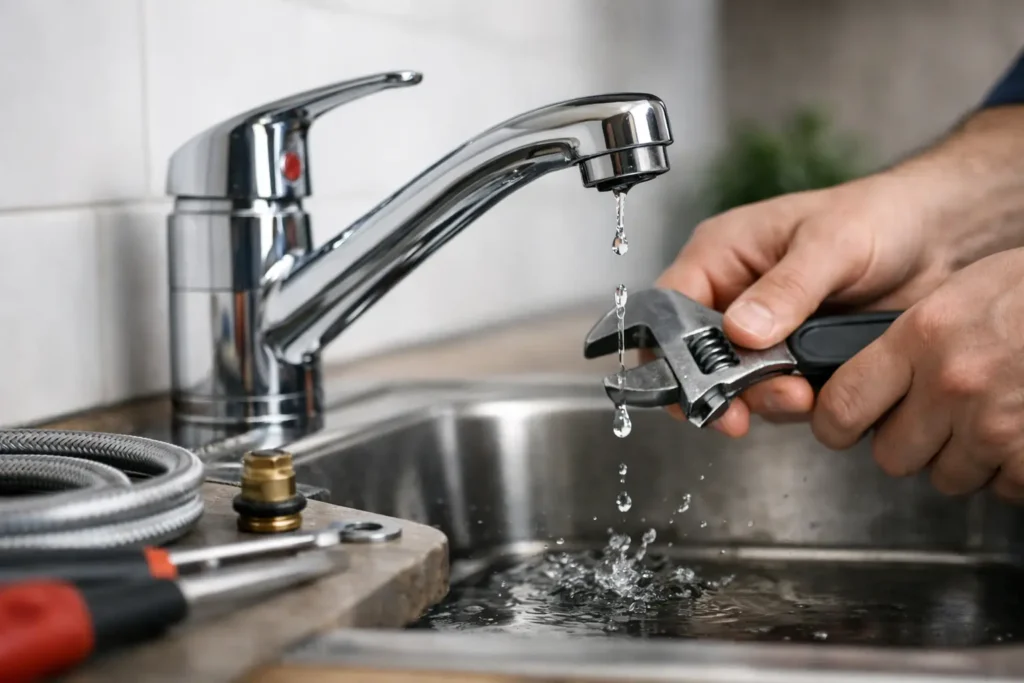
That steady drip at the sink is more than annoying. If you are searching for how to fix leaking faucet problems, you are usually dealing with one of two things – a worn internal part or a bigger plumbing issue starting to show itself. The good news is that many faucet leaks can be handled with a careful repair. The bad news is that not every leak should be treated like a quick DIY job.
A leaking faucet can waste water, stain fixtures, damage cabinets, and quietly raise your utility bill. In kitchens and bathrooms, small leaks also tend to spread. What starts at the handle or spout can end up soaking the base cabinet, loosening caulk lines, or causing hidden moisture around the sink cutout. That is why speed matters.
How to fix leaking faucet starts with the leak source
Before you take anything apart, figure out where the water is coming from. A faucet can leak from the spout, the handle, the base, or the supply line connections underneath the sink. Each source points to a different problem.
If water drips from the spout when the faucet is turned off, the issue is usually inside the valve assembly. That often means a worn washer, damaged cartridge, failed ceramic disc, or corroded valve seat depending on faucet type. If water leaks around the handle while the faucet is running, you may be dealing with a bad O-ring or loose packing nut. If the leak is at the base, the seals under the faucet body may be worn out. If the drip is under the sink, check supply lines, shutoff valves, and drain connections before blaming the faucet itself.
This first step matters because the repair is only as good as the diagnosis. Replacing random parts without finding the true source wastes time and usually does not stop the leak for long.
Know what kind of faucet you have
There is no single answer to how to fix leaking faucet issues because the repair depends on the faucet design. Most residential faucets fall into four categories: compression, ball, cartridge, and ceramic disc.
Compression faucets are the older style with separate hot and cold handles that tighten down to stop water flow. These often leak because a rubber washer has worn out. Ball faucets are common in kitchens and use a rotating ball assembly inside the body. They have more moving parts, which means more possible failure points. Cartridge faucets use a cartridge to control flow and temperature, and repairs usually involve replacing that cartridge or its seals. Ceramic disc faucets are durable, but when they leak, sediment buildup or worn seals are often the cause.
If you are not sure what you have, remove the handle and look at the mechanism. The internal setup usually gives it away. It is worth taking a quick photo before disassembly so you can match parts accurately.
What you need before starting
Most faucet repairs require basic hand tools, not a full workshop. In many cases, an adjustable wrench, screwdriver set, Allen key, needle-nose pliers, plumber’s grease, and replacement parts are enough. You may also want an old towel, a small bucket, and a flashlight for under-sink work.
The most common mistake homeowners make is taking the faucet apart before they have the right replacement parts. That can leave your sink out of service while you run back and forth to the hardware store. If the faucet is older or the brand is unclear, remove the worn part first and bring it with you for a match.
Turn off the water supply at the shutoff valves under the sink before doing anything else. Then open the faucet to release pressure and cover the drain so no screws or clips disappear into it.
How to repair the most common faucet leaks
For a compression faucet, start by removing the decorative cap, unscrewing the handle, and exposing the stem assembly. Once the stem is out, check the rubber washer at the bottom. If it looks flattened, cracked, or stiff, replace it. While you are there, inspect the valve seat. If it is pitted or rough, a new washer alone may not solve the drip.
For a cartridge faucet, remove the handle and retaining clip or nut, then pull the cartridge straight out. If it is stuck, use steady pressure rather than twisting too aggressively. Install a matching replacement cartridge and lubricate any new O-rings with plumber’s grease before reassembly.
For a ball faucet, the repair is usually done with a replacement kit. These kits often include springs, seats, O-rings, and the cam assembly. Because ball faucets have several small parts, it helps to lay them out in order as you remove them.
For a ceramic disc faucet, take off the handle and remove the disc cylinder. Clean any debris from the seals and check for cracks. Sometimes a good cleaning solves the problem. Other times the seal or cartridge needs replacement.
Once the faucet is reassembled, slowly turn the water back on and test both handles or temperature settings. Check the spout, handle, and underside of the sink before calling the job done.
When a leaking faucet is not really a faucet problem
Sometimes the faucet gets blamed for leaks that actually come from nearby plumbing. A loose supply line connection can drip down the body of the faucet and make it look like the base is leaking. A failing shutoff valve can create moisture under the sink that gets noticed only after cabinet damage starts. Even a sink rim leak can run behind the basin and mimic faucet failure.
This is where homeowners can lose time. You replace faucet parts, the leak seems better for a day, and then water shows up again in the cabinet. If you see swelling wood, mold smell, soft cabinet flooring, or water marks on the wall behind the sink, you may be dealing with a bigger repair than a simple faucet service.
When DIY makes sense and when it does not
A basic faucet drip with a clear source and easy access is often a reasonable DIY repair. If you can identify the faucet type, isolate the water, and get matching parts, there is a good chance you can stop the leak.
It gets less simple when the faucet is corroded, the mounting hardware is frozen, the shutoff valves do not work, or the leak has been going on long enough to cause damage. The same is true if the faucet is part of a larger issue, like low water pressure, pipe noise, recurring leaks, or cabinet rot.
There is also the question of age. If the faucet is old, heavily scaled, or loose at the mounting surface, replacing internal parts may buy only a little time. In those cases, a full faucet replacement is often the smarter move. It costs more upfront, but it can save repeat labor and prevent more water damage.
How to fix leaking faucet issues without creating new ones
The fastest way to turn a small repair into a larger one is to force parts that do not want to move. Faucet bodies can crack. Retaining clips can bend. Supply lines can loosen. Under-sink shutoff valves can fail after years of not being touched.
Work carefully and avoid over-tightening during reassembly. Too much torque can damage threads, flatten seals, and create leaks where none existed before. If you run into corrosion, mineral buildup, or a part that feels fused in place, that is usually your sign to stop and reassess.
For busy households, the real cost is not just the part. It is losing use of the kitchen or bathroom sink while a quick repair turns into a longer project. That is one reason many homeowners prefer one call and a finished repair, especially when the leak is affecting daily routines.
Signs it is time to call a professional
You should bring in a pro if the faucet still leaks after replacing the expected part, if the shutoff valves fail, if water is pooling inside the cabinet, or if the leak involves both the faucet and drain area. The same goes for any sign of hidden damage.
Professional repair also makes sense when you want the problem solved quickly and correctly the first time. At Cobo Kitchen Master & Home Repair, that often means not only stopping the leak, but checking the surrounding sink connections, cabinet condition, and fixture mounting so the problem does not come right back.
A faucet leak is small until it is not. Water has a way of finding weak spots, especially around wood cabinets, countertop seams, and older plumbing connections.
If you are dealing with a drip today, handle it now while it is still a faucet repair and not a cabinet, countertop, or wall repair tomorrow.